In this guide
- 01Why is my roof leaking? The ten most common causes, ranked
- 02How water travels: the stain is rarely below the entry point
- 03How to find a roof leak from the attic
- 04Finding the leak from outside
- 05Roof leaking in heavy rain versus a roof leak in winter
- 06What to do in the first hour
- 07DIY temporary measures that help, and ones that make things worse
- 08What professional roof leak repair involves
- 09Roof leak repair cost in 2026
- 10When a leak means the roof needs replacing
- 11Leaking roof in Airdrie? Get it found and fixed properly
Why is my roof leaking? The ten most common causes, ranked
Roof leak repair is easier when you know what you are most likely looking for. Roofs rarely leak through the middle of a sound shingle. They leak at joints, penetrations and edges, and in Canada they leak at the eaves in winter for reasons that have nothing to do with holes. Here are the ten causes we see most, in rough order of how often they turn out to be the culprit.
- 1. Flashing failure at chimneys, walls, skylights and valleys: rusted, lifted, badly installed or sealed with caulk that has cracked.
- 2. Cracked pipe boots on plumbing vents: the rubber collar splits after 8 to 15 years of UV and cold.
- 3. Ice dams at the eaves: meltwater backs up under the shingles in winter and early spring.
- 4. Wind-lifted or missing shingles: a Chinook or prairie gust breaks the seal and rain drives under the tab.
- 5. Hail damage: bruised or cracked shingle mats that open up a season or two after the storm.
- 6. Exposed or popped nails: nail heads that have backed out through the shingle above, or nails driven through the wrong spot.
- 7. Failed vent or skylight seals: rusted vent bases, cracked plastic, dried skylight gaskets, and condensation that looks like a leak.
- 8. Blocked eavestroughs and valleys: debris dams water until it overtops the underlayment or runs behind the fascia.
- 9. Worn-out shingles: curling, cracked and granule-bare shingles that no longer shed water, usually past year 18 to 20.
- 10. Condensation and attic frost: not a roof leak at all, but a warm, humid attic that frosts in winter and drips when it thaws.
The first three account for most calls. If your leak is near a chimney, a vent or an exterior wall, or it only shows up in winter, start there. Our guide to roof flashing repair and chimney leaks goes deep on cause number one.
How water travels: the stain is rarely below the entry point
The most common mistake in finding a roof leak is looking straight up from the stain. Water enters the roof at a flashing or a crack, lands on the underlayment or the deck, and runs downhill. It follows a rafter, drips onto the insulation, wicks across a vapour barrier and finally shows on the ceiling at a seam, a light fixture or a low point in the drywall. The distance can be a metre or five metres.
Because roofs slope, the entry point is almost always uphill of the stain, and often off to one side because the water followed a rafter or truss chord. On a truss roof the water can also travel along the bottom chord horizontally before it finds a way through. Skylight shafts, chimney chases and plumbing walls act as channels that carry water from an upper roof to a ceiling on the floor below.
How to find a roof leak from the attic
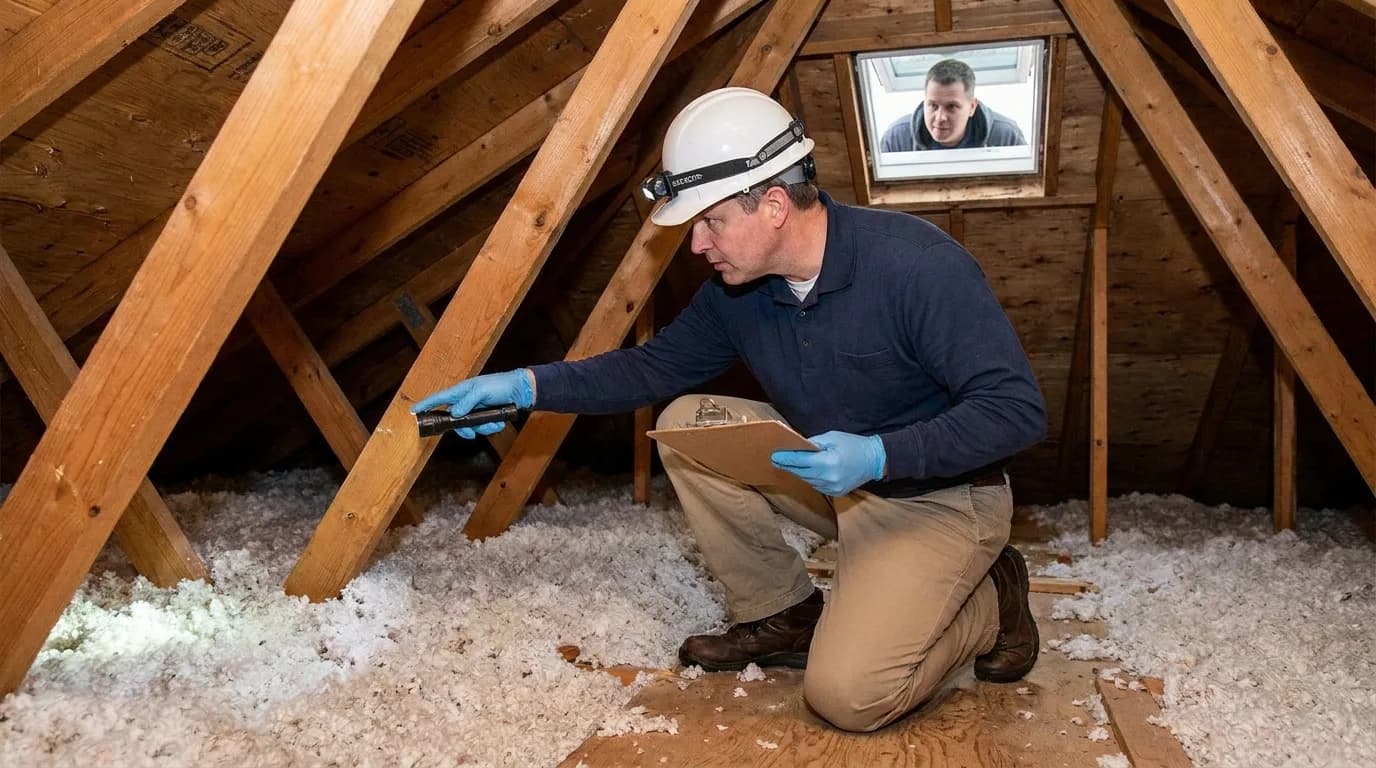
The attic is where the evidence lives. If you can get into it safely, go up during a rainstorm or a strong thaw, because a dry attic on a sunny day tells you much less. Bring a bright flashlight, a tape measure and your phone for photographs. Stay on the joists or a plank, never on the drywall.
- Look for water first: drips, wet insulation, a shine on the underside of the deck, or water running down a rafter.
- Follow any wet trail uphill to its highest point. That is the entry, or close to it.
- Check every penetration you can see: plumbing stacks, vent housings, the chimney chase, skylight shafts, bathroom fan ducts.
- Look for daylight with the flashlight off. Even a pinhole shows.
- Look for old stains: dark rings or black mould on the deck mark places that have leaked before, even if they are dry now.
- Check for frost or white streaks on the underside of the deck and on nail tips in winter; that is condensation, not a roof leak.
- Measure from the wet spot to a known reference such as the chimney, a gable end or a vent, so it can be located from outside.
A wet patch that fades toward the eave and is soaked at the top usually means a leak at a penetration or the ridge. A wet strip along the bottom edge of the deck, worst at the eaves and worse on north or shaded slopes, means an ice dam. Wet insulation everywhere, with no clear trail, points at condensation or a ventilation problem, and our guide to attic ventilation and roof vents in Alberta explains how to sort that out.
Finding the leak from outside
From the ground, binoculars find a surprising amount. Look for missing or lifted shingles, shingles with the tab flapping, dark patches where granules have gone, rust streaks below flashing, lifted counter flashing on the chimney, cracked or leaning vent boots, and debris packed in a valley. Check the eavestroughs for a drift of granules, which means the shingles are shedding.
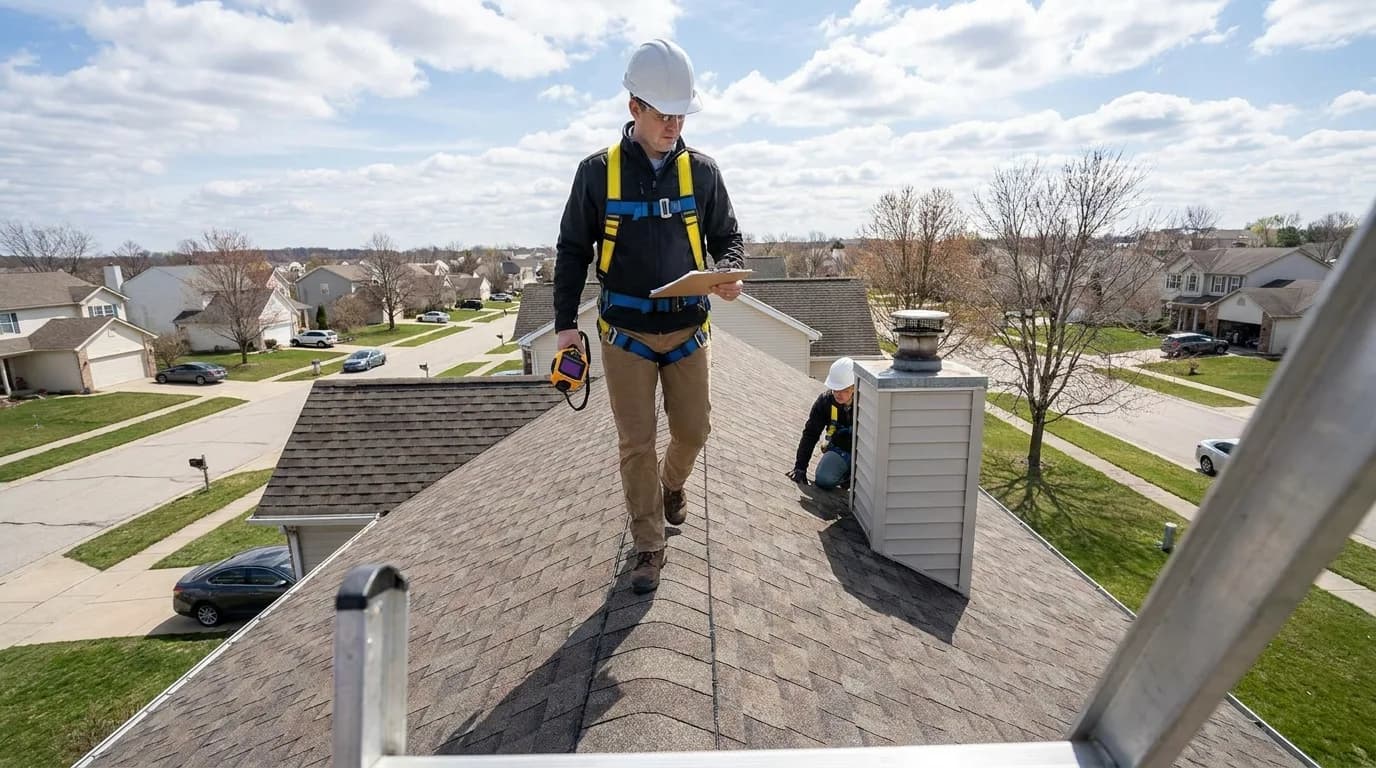
If you go on the roof, do it only on a dry, calm day, on a slope you can walk comfortably, with someone else at home. Most leaks are found within a metre of a penetration or a change in plane. Press on shingles near the suspect area; a soft deck means water has been there for a while. Do not pull shingles up on a cold day, because they crack.
A hose test is the last resort. With a helper in the attic, run water from a garden hose onto one section of the roof at a time, starting low and moving up, for several minutes each. When the helper sees water, you have found the section. It is slow and it is not a job for a steep roof, but it settles arguments about intermittent leaks that only show in certain storms.
Roof leaking in heavy rain versus a roof leak in winter
Leaks in summer and leaks in winter usually have different causes, and the pattern tells you a lot. A roof leaking in heavy rain, especially rain driven sideways by wind, is most often flashing, lifted shingles, exposed nails or a blocked valley. The leak starts within an hour of the rain, stops when the rain stops, and tends to be at a penetration or a wall. Hail damage behaves the same way but often shows up a season after the storm, when the bruised shingles finally crack.
A roof leak in winter is different. In most of Canada the two big winter causes are ice dams and attic frost. An ice dam leak appears during or right after a thaw, usually on the ceiling near an exterior wall or at the top of a window, and is worst on slopes that hold snow. Frost melt appears on a sunny cold day or the first warm afternoon, often in the middle of a room, and is caused by a winter's worth of humid house air freezing on the underside of the deck and then letting go all at once.
A leak that shows up in both seasons, in the same place, is usually flashing or a penetration. A leak that only appears in spring during the melt is nearly always an ice dam or a snow-packed valley. If you are seeing the winter pattern, our guide on how to prevent ice dams in Airdrie explains the attic-side fixes that stop it for good.
What to do in the first hour
Water coming through a ceiling is alarming but rarely an emergency for the structure. It is an emergency for the drywall, the insulation and anything under it. Deal with those first, and the roof second.
- Move furniture and electronics out from under the leak and put down a bucket or bin with a towel in it to stop the splash.
- Relieve a bulging ceiling by pushing a screwdriver through the lowest point of the bulge into a bucket. A controlled hole is far better than a collapsed sheet of drywall.
- Turn off power to any light fixture or outlet that water is reaching, at the breaker.
- Photograph and video everything: the stain, the drip, the room, the weather outside. If this becomes an insurance claim, the timeline matters.
- Note the time, the weather and where the water is, because that is exactly what a roofer will ask.
- Go to the attic if you safely can and lay a tarp or plastic over the insulation under the leak, with a container to catch drips.
- Do not go on the roof in rain, wind, snow or ice. Nothing you do up there in a storm is worth the fall.
DIY temporary measures that help, and ones that make things worse
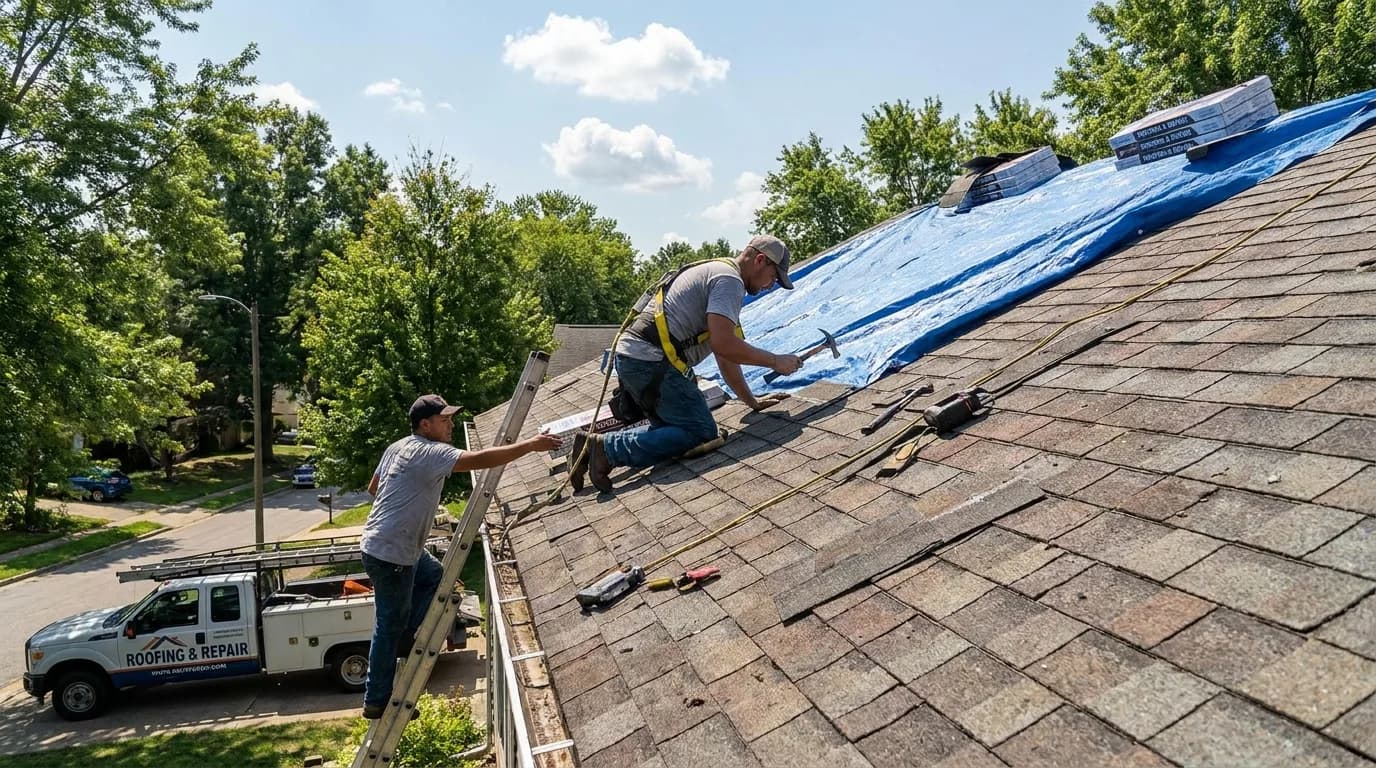
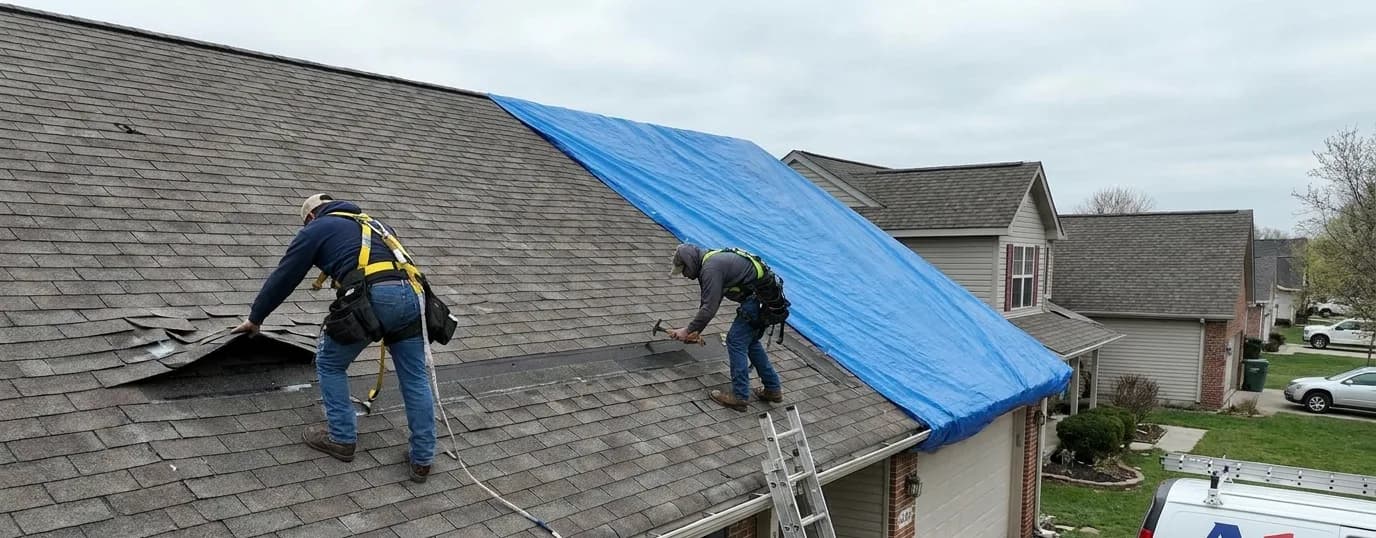
If the leak is active and the weather is closing in, a few temporary measures buy time. The best is a tarp: a heavy poly tarp laid over the suspect area, running from above the ridge down past the leak, held down with 2x4s screwed through the tarp into the deck at the edges, never with bricks or loose weights that blow off. Done from a ladder on a dry, calm day, it holds for weeks. Done in a storm, it is how people get hurt, which is why emergency tarping is a service roofers offer.
On a small, obvious fault such as a split pipe boot, a wrap of self-adhesive flashing tape or a smear of roofing sealant around the collar stops the drip until a real replacement. A lifted shingle tab can be resealed with a dab of asphalt roofing cement under the tab on a warm day. An exposed nail head can be sealed with polyurethane sealant.
What not to do: do not spread roof cement over a whole area as a DIY fix, because it traps water, hides the fault and has to be scraped off later; our roof coating and sealant guide explains where a proper coating product is actually appropriate. Do not chip at an ice dam with a hammer or an axe. Do not pour hot water on ice. Do not use pressure washers or salt on shingles. And do not leave a temporary fix as the permanent one; the next stage of the leak is rot in the deck, which turns a $400 repair into a $2,000 one.
What professional roof leak repair involves
A professional starts with a diagnosis, not a tube of caulk. That means the attic, the roof surface and the suspect penetrations looked at together, often with the homeowner's photographs and the weather pattern to narrow the search. Good roofers explain what they found, show you the photographs, and quote the repair itemised: what is being removed, what is being installed, and whether any deck is being replaced.
The repair itself depends on the cause. A pipe boot is replaced with the surrounding shingles lifted and re-laid. Flashing is rebuilt in the correct layers with new membrane behind it, and around a chimney that usually means our dedicated chimney flashing repair service rather than a quick patch. Wind-lifted shingles are replaced, not glued, and the courses above checked for broken seals. A soft deck section is cut out and replaced with new sheathing before anything goes back over it. An ice dam leak gets ice-and-water membrane at the eaves if it was missing, plus a conversation about the attic.
Roof leak repair cost in 2026
Most leaks are small jobs. As a rough 2026 guide for the Alberta market, the common repairs run in the ranges below. Access, pitch, roof age and any deck rot move the number, and these are market guides rather than quotes.
| Cause of leak | Typical repair | Rough 2026 cost (guide) |
|---|---|---|
| Cracked pipe boot | Boot replacement, shingles re-laid | $200–$450 |
| Exposed nails, a few lifted tabs | Reseal or replace shingles, seal nail heads | $300–$600 |
| Failed vent or skylight seal | Vent replacement or skylight reseal | $250–$800 |
| Chimney or wall flashing | Reflash with new step and counter flashing | $600–$1,800 |
| Wind-damaged slope | Replace shingles across the affected area | $500–$2,500 |
| Ice dam leak | Membrane at eaves, shingle repair, attic advice | $800–$2,500 |
| Deck rot under any of the above | Add per sheet of sheathing replaced | $150–$400 per sheet |
| Emergency tarping | Same-day tarp and temporary seal | $300–$1,000 |
Storm-caused leaks, from hail or wind, may be an insurance matter rather than a repair bill, and our guide on whether home insurance covers roof leaks covers the distinction between sudden damage and wear. For a fuller breakdown of repair pricing, see our roof repair cost guide for Airdrie.
When a leak means the roof needs replacing
A single leak on a roof under 15 years is a repair. A leak on a roof past 20 years, especially the second or third one, deserves a harder look. The question is whether the leak is an isolated fault on a sound roof or the first symptom of a roof that has reached the end. Curling shingles, granules in the eavestroughs, multiple soft spots on the deck, and flashing that is failing in more than one place all say the latter.
The arithmetic helps. If repairs in a year add up to a quarter or a third of a reroof, or if the roofer tells you the shingles are too brittle to lift without breaking the ones around them, you are paying to postpone rather than to fix. Our roof repair versus replacement guide works through the decision with numbers, and the pillar guide to the signs you need a new roof lists what to look for on your own roof before you call anyone.
Leaking roof in Airdrie? Get it found and fixed properly
Everything above applies anywhere in Canada. If you are in Airdrie or the surrounding area, Apex Roofing Airdrie will do the diagnosis for you: a free on-site inspection covering the attic, the roof surface and every penetration, with photographs and an itemised written quote for the repair. Our roof repair service in Airdrie is done by our own local crew with a written workmanship guarantee on top of the manufacturer warranty, and estimates can usually be booked the same week.
If water is coming in right now, our emergency roof repair in Airdrie covers same-day tarping and a temporary seal so the permanent fix can be done when the roof is dry, and our step-by-step guide on how to fix a leaking roof walks through the same sequence. And if the leak came with hail or wind, we document the damage and support your insurance claim as part of the job.
Written by the Apex Roofing Airdrie crew
Practical guidance from the local roofers who inspect, repair and replace roofs across Airdrie and Rocky View County every season. We review our guides against current Alberta practice and update them when materials, code or insurer behaviour changes. About our team.