In this guide
- 01What roof flashing is and why it is the number one leak source
- 02Types of roof flashing and what each one does
- 03Why flashing fails in Alberta: Chinooks, hail and sealant
- 04Chimney flashing repair: the most common serious flashing leak
- 05Pipe boot replacement and vent flashing
- 06Wall, kick-out, valley and skylight flashing leaks
- 07What a proper flashing repair looks like versus a caulk-only patch
- 08Roof flashing repair cost in 2026
- 09Storm-lifted flashing and insurance
- 10How to spot flashing problems from the ground
- 11Fix the joint properly and the roof will last
What roof flashing is and why it is the number one leak source
Roof flashing repair is the most common repair we do, and the reason is simple: flashing is where the roof stops being a continuous surface. Every place a chimney, wall, vent pipe, skylight or valley interrupts the shingles, a piece of metal or rubber has to bridge the gap and send water back onto the roof. Shingles overlap and shed water almost automatically. Flashing has to be shaped, layered and sealed by hand, and it has to keep doing its job while the roof, the chimney and the wall all move at different rates.
That is why a 15 year old roof with sound shingles can still leak. The shingles are fine. The step flashing behind the chimney has rusted through, the counter flashing has pulled out of the mortar joint, or the rubber boot on the plumbing vent has split. Water finds the gap, follows a rafter and shows up as a stain two metres from where it got in.
If you have a leak and the shingles look intact from the ground, flashing is the first suspect. If the shingles are curling and bare as well, the flashing is only part of a bigger problem, and our pillar guide to the signs you need a new roof will help you weigh a repair against a reroof.
Types of roof flashing and what each one does
Roofers use a handful of flashing types, and knowing the names helps you understand a quote. The table below covers the ones you will find on a typical Airdrie home.
| Flashing type | Where it goes | What it does | Common failure |
|---|---|---|---|
| Step flashing | Where a sloped roof meets a wall or chimney side | L-shaped pieces woven between each shingle course, one per course | Rust, missing pieces, nailed through the face, buried under caulk |
| Counter flashing | Over the top of step flashing on chimneys and masonry walls | Covers the top edge of the step flashing; set into a mortar joint | Pulls out of the mortar, sealant fails, replaced with surface caulk |
| Apron or head flashing | Front (downhill) face of a chimney or dormer | Directs water from the roof surface over the shingles below | Lifts in wind, corrodes, too short |
| Back pan or cricket | Uphill side of a wide chimney | Splits water around the chimney instead of letting it pool | Missing on older homes; leaks and rot behind chimney |
| Valley flashing | Where two roof slopes meet | Carries concentrated water down the valley | Rust, hail dents, shingles cut too close, debris dams |
| Pipe boot (vent flashing) | Around plumbing vents | Rubber collar on a metal base seals the pipe | Rubber splits from UV and cold after 8–15 years |
| Kick-out flashing | Bottom of a roof-to-wall joint | Kicks water out into the eavestrough instead of behind the siding | Often missing; causes rot inside the wall |
| Drip edge | Along eaves and rakes | Sends water off the deck edge into the trough | Missing, installed under instead of over the membrane |
Two of these deserve their own mention. Drip edge is not usually a leak source on its own but it protects the deck edge from ice dam water, and our guide to drip edge explained covers why a missing one matters in Alberta. Kick-out flashing is the one most often absent on homes built through the 2000s, and its absence is behind a surprising number of rotten wall corners in Airdrie subdivisions.
Why flashing fails in Alberta: Chinooks, hail and sealant
Flashing depends on two things that Alberta weather attacks: metal that stays where it was put, and sealant that stays flexible. Chinooks undermine both. A swing from minus 25 to plus 8 in a day makes aluminum, steel, brick and asphalt all expand and contract by different amounts. Over hundreds of cycles the counter flashing works out of its mortar joint, nail heads back out, and the sealant that was supposed to bridge the gap tears.
Hail finishes the job. Soft aluminum flashing and rubber pipe boots take hits the same way shingles do. A dented valley holds water. A boot that was already chalky from UV splits at the first quarter-sized stone. In Hailstorm Alley, a storm like the one that tracked down the Crossfield to Airdrie corridor on the evening of August 8, 2026 leaves hundreds of pipe boots and chimney flashings compromised even where the shingles survived.
Chimney flashing repair: the most common serious flashing leak
Chimneys are the worst case for flashing. They are wide, they sit in the middle of the slope, they are made of a material that moves differently from the roof, and on older Airdrie bungalows they often have no cricket on the uphill side, so snow and water pile up behind them; our chimney cricket explained guide covers what that piece does and when one should be added. Chimney flashing repair is what most homeowners searching for a flashing leak end up needing, and our dedicated chimney flashing repair service in Airdrie handles exactly this job.
A proper chimney reflash has three layers. Step flashing is woven into each course of shingles along both sides. An apron covers the front. A back pan or cricket handles the uphill side. Then counter flashing is cut into a mortar joint about 4 cm deep, bent down over the top of all of it, and sealed at the reglet. Water that gets behind the counter flashing lands on the step flashing and runs back out onto the shingles. No single layer has to be perfect.
What we often find instead is a single sheet of metal glued to the brick with caulk and lapped over the shingles, or counter flashing that was simply pressed against the mortar and sealed. Both leak within a few years. On a brick chimney that also has spalling or crumbling mortar, the masonry needs repointing before the flashing can be set into it, and a roofer will usually tell you to bring in a mason first rather than sealing over the problem.
Pipe boot replacement and vent flashing
The humble plumbing vent boot is responsible for more small leaks than anything else on an Airdrie roof. The rubber collar that grips the pipe faces south-facing UV all summer and minus 30 all winter, and after 8 to 15 years it cracks at the top where it meets the pipe. Water runs down the outside of the pipe, into the attic, and shows up as a stain in the bathroom ceiling or a wet patch on the insulation.
Replacement is straightforward when done properly: lift the shingles above and beside the boot, remove the old flashing, slide in a new one with the base under the upper shingles and over the lower ones, seal the nail heads, and re-lay the shingles. On a roof past 15 years the surrounding shingles can be too brittle to lift without cracking, which is when a roofer might fit a retrofit boot that slips over the existing one instead.
Ridge vents, box vents and turbine vents fail at their bases in the same way. If the vent housing has rusted, the nail holes have opened up, or a hailstorm has cracked the plastic, the whole unit is replaced rather than patched. Vents are also the moment to check ventilation is adequate; our guide to roof vent types covers what each kind does.
Wall, kick-out, valley and skylight flashing leaks
Where a roof runs into a vertical wall, for example a bonus room over a garage or a two-storey section beside a one-storey roof, step flashing does the work and siding or stucco covers its top edge. Leaks here are often blamed on the roof but are really siding problems: stucco run down over the flashing, siding with no gap for water to escape, or house wrap lapped the wrong way.
Kick-out flashing sits at the bottom of that wall joint. Without it, water running down the step flashing shoots straight behind the siding at the bottom corner. Look for a stained or bulging corner of siding at ground level below any roof-to-wall joint; that is the sign. Adding a kick-out is a small job that can save a wall.
Valleys leak when metal rusts, when hail dents create pools, or when shingles were cut so close that the valley centre is covered. Skylights are a category of their own: curb flashing kits, deteriorated seals and condensation all look like a flashing leak from below. Our guide to why skylights leak and how to repair them separates the causes.
What a proper flashing repair looks like versus a caulk-only patch
There are two kinds of roof flashing repair and they cost very different amounts because they are very different jobs. The caulk-only patch runs a bead of sealant along every visible edge, sometimes with a smear of roof cement over the top. It takes 20 minutes and it can stop a leak for a season or two. It also traps water behind it, hides the real fault, and makes the eventual proper repair harder because everything is glued together.
A proper repair starts by removing the shingles and old flashing around the joint so the roofer can see the deck, the underlayment and the cause. Rotten decking is replaced. New ice-and-water membrane goes around the penetration or up the wall. New flashing is fitted in the right sequence, each piece lapping over the one below, and the shingles are re-laid over it. Sealant is used only where the design calls for it, at counter flashing reglets and nail heads, not as the primary waterproofing. For the cases where a coating genuinely is the right fix, such as an aging flat membrane, our roof coating and sealant guide explains when that applies.
Roof flashing repair cost in 2026
Flashing repairs are priced by the joint, not by the square, because the work is almost all labour and access. The ranges below are rough Airdrie-area market guides as of 2026 for a proper repair with new materials on a standard-pitch asphalt roof. Steep roofs, three-storey access, brittle old shingles and deck rot push jobs to the top of the range or beyond. They are not quotes.
| Repair | What it usually involves | Rough 2026 cost (guide) |
|---|---|---|
| Pipe boot replacement | New boot flashing, lift and re-lay surrounding shingles | $200–$450 |
| Box or turbine vent replacement | New vent, flashing and shingles | $250–$600 |
| Kick-out flashing added | Cut siding, fit kick-out, seal | $250–$600 |
| Roof-to-wall step flashing rebuild, per side | Remove siding edge and shingles, new step flashing and membrane | $500–$1,500 |
| Chimney reflash | Step, apron, back pan and counter flashing cut into mortar | $600–$1,800 |
| Chimney reflash with new cricket | As above plus framing and sheathing a cricket | $1,200–$2,500 |
| Valley flashing replacement | Strip valley, new metal or membrane, re-lay shingles | $800–$2,500 |
| Caulk-only patch | Sealant over existing flashing, no removal | $150–$350 |
For context, the same jobs done as part of a full reroof add little to the price because everything is already off. If your roof is past about 18 years and has two or three flashing problems at once, the arithmetic can favour replacement; our roof repair cost guide for Airdrie sets flashing repairs against other common jobs so you can compare.
Storm-lifted flashing and insurance
Flashing that has simply aged out is maintenance, and no policy covers it. Flashing that was lifted by a Chinook gust, dented flat by hail, or torn when wind stripped the shingles around it is storm damage, and in Alberta that is usually a claimable event on a standard homeowner policy. The distinction matters, so document it: photographs of the lifted or dented metal, the date of the storm, and the leak that followed.
Adjusters look at flashing along with the shingles, and hail-dented soft metals such as valley flashing, vent caps and eavestroughs are often what confirms a hail event on a roof where the shingle damage is subtle. Many insurers require hail claims within 12 months of the storm, and Alberta homeowners choose their own contractor, so you are not obliged to use whoever the insurer suggests. Confirm your policy terms with your insurer or broker.
Our guide to wind damage and lifted shingles after a Chinook covers what wind damage looks like and how to document it. Apex Roofing Airdrie documents storm damage and supports the claim as part of the repair; it is not legal or insurance advice, just the paperwork done properly.
How to spot flashing problems from the ground
You do not need to climb up to catch most flashing problems early. Walk around the house with binoculars after a rain, and look for:
- Rust streaks below a chimney, valley or vent, which mean the metal is corroding.
- Gaps or lifted edges where counter flashing meets brick, or a visible line of dried, cracked caulk.
- Shiny or tarry patches around a chimney or vent, which mean someone has already done a caulk-only repair.
- A pipe boot that looks chalky, grey or cracked at the collar, or with the rubber pulled away from the pipe.
- Dented or wavy valley metal after a hailstorm.
- Stained or bulging siding at the bottom corner of a roof-to-wall joint, which points to missing kick-out flashing.
- Ceiling stains near a chimney, exterior wall or bathroom that show up after heavy rain or a thaw.
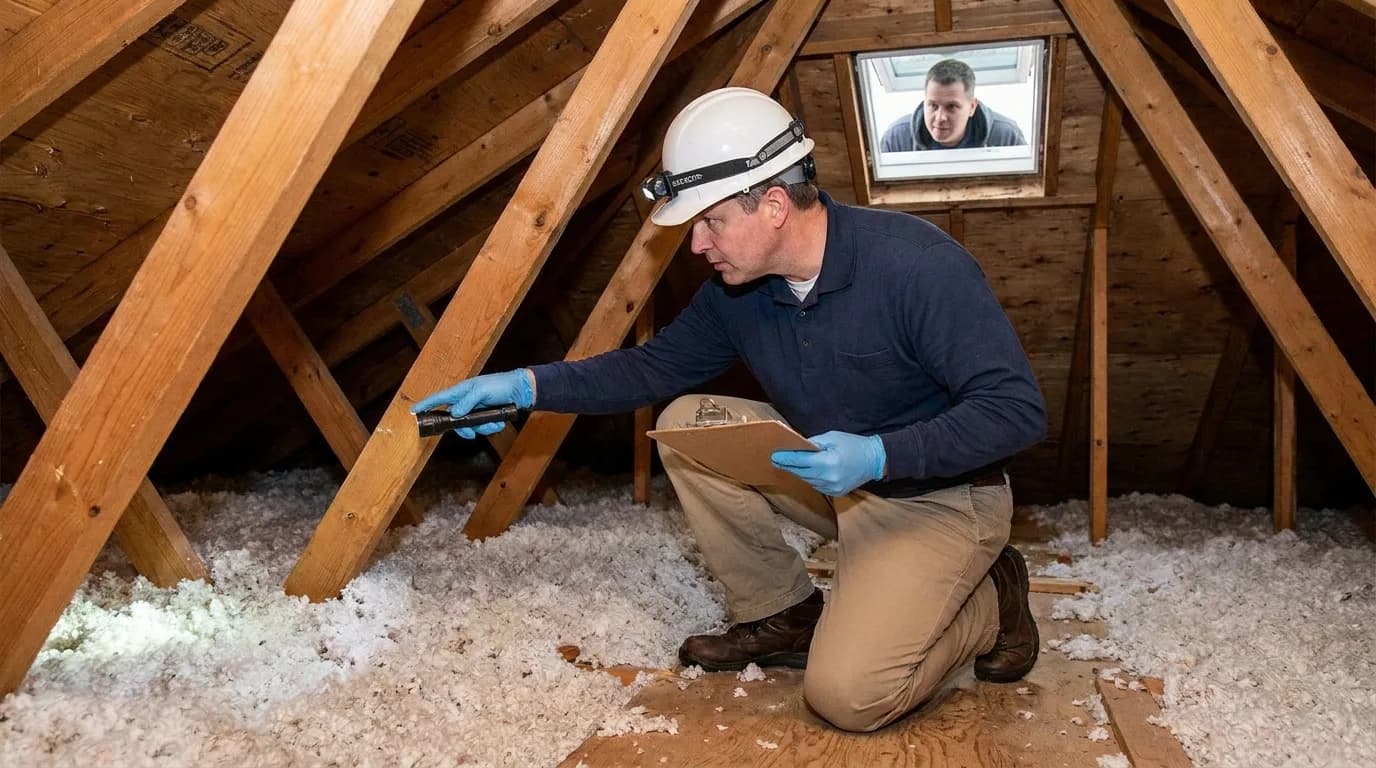
- Daylight or water marks in the attic around any penetration when you look up with a flashlight.
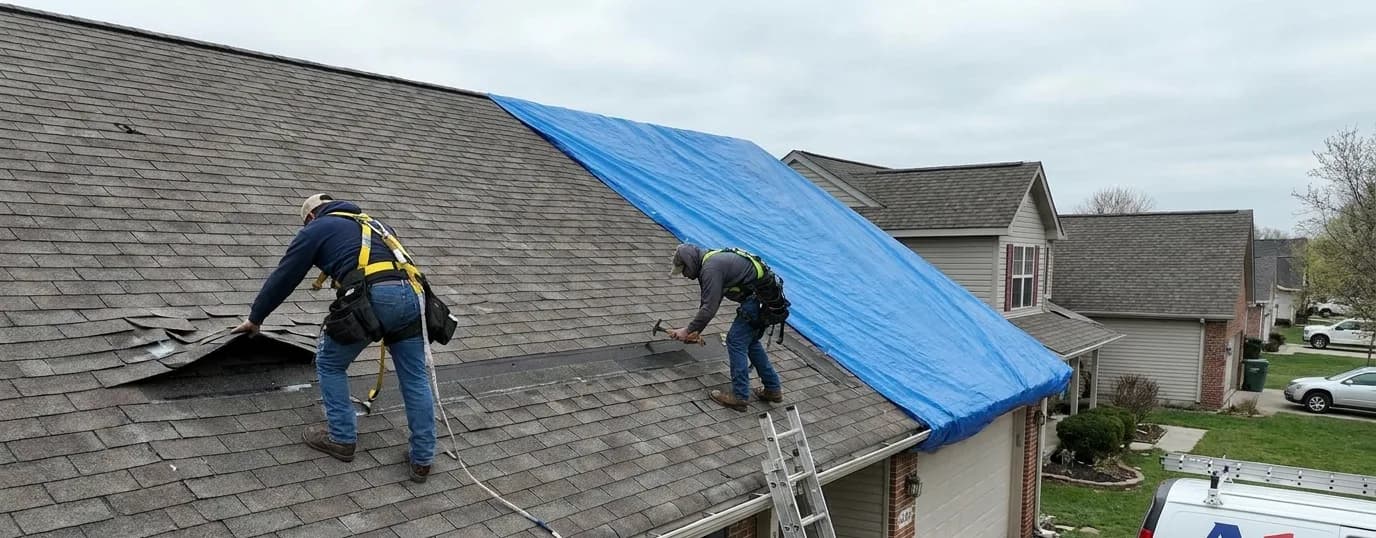
Any one of these is worth a closer look before it becomes a leak. If water is already coming in during a storm, emergency roof repair in Airdrie covers tarping and a temporary seal so the permanent flashing repair can be done when the roof is dry, and our guide on how to fix a leaking roof covers the immediate steps in the meantime.
Fix the joint properly and the roof will last
Most flashing leaks are small, cheap and quick to fix when caught early, and expensive when they are left to rot the deck, the framing and the drywall below. The difference is usually a spring and fall look at the chimney, the vents and the wall joints, and a proper repair the first time rather than a bead of caulk every year.
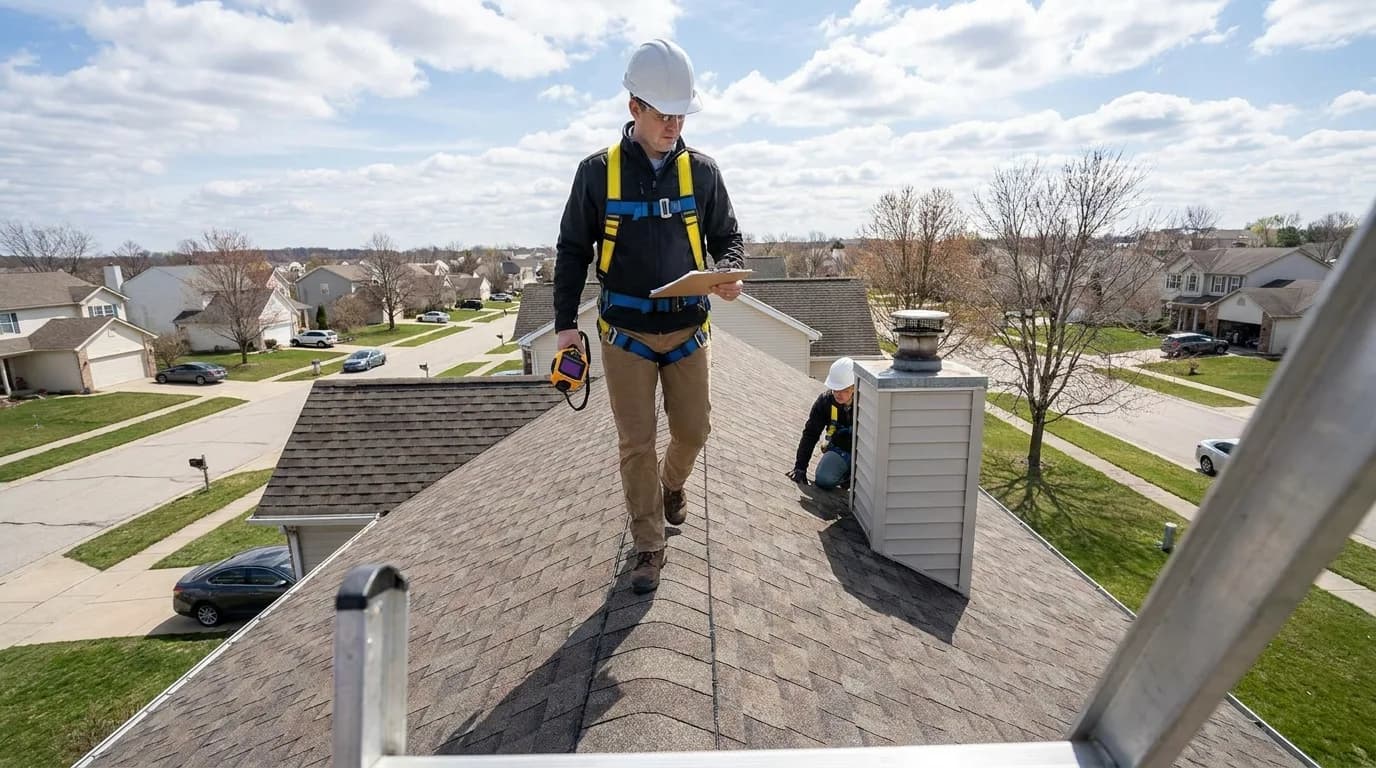
If you have a stain, a suspect chimney or a boot that looks past it, our roof repair service in Airdrie starts with a free on-site inspection and an itemised written quote that says exactly which flashing is being replaced and how. Every repair carries our written workmanship guarantee, and if the damage came from a storm, we document it for your claim.
Written by the Apex Roofing Airdrie crew
Practical guidance from the local roofers who inspect, repair and replace roofs across Airdrie and Rocky View County every season. We review our guides against current Alberta practice and update them when materials, code or insurer behaviour changes. About our team.