In this guide
- 01What is drip edge on a roof?
- 02Drip edge flashing profiles: Type C, Type D, F-style and gutter apron
- 03Where drip edge goes in the layer stack: under at the eaves, over at the rakes
- 04What it protects against on an Alberta roof
- 05Drip edge vs gutter apron: which one do you need?
- 06Why older Airdrie roofs often have no it
- 07Drip edge installation: what a good crew does
- 08How much does it cost in Alberta?
- 09How to check your drip edge from the ground
- 10Getting the edges right on your next roof
What is drip edge on a roof?
Drip edge is a length of bent metal flashing, usually aluminum or galvanized steel, that runs along the eaves and rakes of a roof. It sits at the edge of the roof deck, tucked under the underlayment or shingles, with a lip that hangs down past the fascia. Water running off the shingles hits the metal, follows the hanging lip, and drops cleanly into the eavestrough (gutter) or away from the wall.
Without it, water clings to the underside of the shingle overhang by surface tension and wicks back onto the edge of the deck, the fascia board and the top of the eavestrough. That wicking is slow, invisible from the ground, and it is the reason so many older Airdrie homes have a soft, stained or peeling fascia even though the shingles look fine.
Drip edge is a small line item on a roof replacement quote, often a few hundred dollars on an average home, and it is the piece most likely to be quietly left off a cheap bid. This guide covers what it does, the profiles you will see, where it goes in the layer stack, what it costs and how to check whether your roof has any.
Drip edge flashing profiles: Type C, Type D, F-style and gutter apron
Roof the flashing comes in a few standard profiles, and roofers use a mix of names for them. The letters below follow the designations you will see on supplier sites, but ask your roofer to show you the actual piece rather than relying on a label, because the same shape gets called three different things in three different yards.
| Profile | Also called | Shape | Where it is used | Notes |
|---|---|---|---|---|
| Type C | L-style | Plain 90 degree bend with a short hem at the bottom | Rakes, budget eave installs | Least expensive, and the least effective at throwing water clear of the fascia |
| Type D | T-style, D-metal | Roof flange, a small outward kick at the top of the face, then a hemmed lip | Eaves and rakes on most quality reroofs | Kicks water further from the fascia; the most common choice on new Alberta roofs |
| F-style | Extended flange, F-metal | Longer vertical face that reaches down toward the eavestrough | Eaves, especially retrofits over existing shingles | Longer flange slides under shingles on an existing roof |
| Gutter apron | Eave flashing | Wide roof flange with a long angled face that lays into the eavestrough | Eaves on low slopes and with large eavestroughs | Best at directing water into the trough; never used on rakes |
Material matters as much as profile. Aluminum is the most common because it does not rust and comes in white, brown and a range of colours to match the fascia. Galvanized or pre-painted steel is stiffer and handles ladders and ice loads better but can rust at cut edges. Whatever the metal, look for at least a 50 mm (2 in) roof flange and a hemmed drip lip that is stiff enough not to bend when the eavestroughs are hung.
Where drip edge goes in the layer stack: under at the eaves, over at the rakes
The single most common it installation mistake is putting it in the wrong layer. The rule is simple once you picture water running downhill. At the eaves, drip edge goes directly on the bare deck, and the ice and water shield and underlayment lap over the top of it. That way, any water that gets under the shingles runs down the membrane, over the metal and off the roof.
At the rakes, the sloped side edges of a gable roof, it is reversed. The underlayment goes on first, and the the flashing is installed over the underlayment. Wind pushing rain sideways up the rake hits the metal and cannot get under the felt or synthetic sheet. If you memorise one thing from this guide, memorise under at the eaves, over at the rakes.
The eave piece is installed first, then the rake pieces overlap it at the corner so water from the rake sheds onto the eave metal rather than behind it. Pieces are lapped at least 50 mm (2 in) in the direction of water flow, fastened every 200 to 300 mm with roofing nails through the roof flange only, and never nailed through the face. Starter shingles then sit flush with the outer edge of the metal, with the first full course overhanging the the flashing by roughly 6 to 10 mm. Our post on roof underlayment types shows how these layers sit together.
What it protects against on an Alberta roof
Drip edge earns its keep in four ways, and three of them are worse in Airdrie than in a mild, still climate.
- Fascia and deck rot: Water that wicks under the shingle overhang soaks the deck edge and the fascia board behind the eavestrough. Over a few seasons that turns into soft wood, peeling paint and eavestrough hangers pulling loose. Drip edge breaks the surface tension and keeps the water on the metal.
- Wind-driven rain: Prairie wind and Chinook gusts push rain sideways and uphill. Without rake it, that water gets under the underlayment at the gable ends and shows up as a stain on the ceiling near an exterior wall.
- Ice creeping under shingles: In a freeze-thaw cycle, meltwater refreezes at the cold eave and wedges upward under the first course. Drip edge, combined with ice and water shield, gives that ice nowhere to go but out. It is part of the system covered in our guide to preventing ice dams in Airdrie.
- Pests and wind uplift: The metal closes the gap between the deck and the fascia so wasps, birds and squirrels have a harder time getting into the soffit, and it gives the shingle edge a stiff backing that resists lifting in wind.
None of these are dramatic on day one. They are five and ten-year problems, which is exactly why homeowners rarely notice that the flashing is missing until the fascia needs replacing along with the roof. Compared with a soffit and fascia replacement bill, a few hundred dollars of metal is cheap insurance.
Drip edge vs gutter apron: which one do you need?
Drip edge vs gutter apron is really a question about the eaves. Standard Type D drip edge works well when the eavestrough is hung close to the roof edge on a normal pitch and the shingle overhang is correct. Its short face drops water cleanly into the trough and it is what you will find on most new roofs in Cooper's Crossing, Bayside and Kings Heights.
Gutter apron has a longer, angled face that lays down into the back of the eavestrough. It is the better choice on low-slope sections where water moves slowly, where the eavestrough hangs a little low or far out, on retrofits where the metal has to slide under existing shingles, and anywhere you have already seen water running behind the trough. Some roofers use gutter apron on every eave as standard, and there is nothing wrong with that.
Rakes never need gutter apron, because there is no eavestrough on a rake. Use a Type C or Type D there. If your eavestrough in Airdrie is being replaced at the same time as the roof, ask the crew to coordinate: the apron goes on before the new trough is hung, and the trough is hung so its back edge tucks under the metal.
Why older Airdrie roofs often have no it
Does a roof need the flashing? Modern good practice says yes at every eave and rake, and most shingle manufacturers call for it in their installation instructions. But plenty of Airdrie homes built through the 1980s, 1990s and early 2000s went up without it, and a surprising number of reroofs since then skipped it too.
There are a few reasons. Drip edge was not universally specified in older residential practice, so original builders often left it off. On reroofs, the cheapest way to win a bid is to leave out the accessories the homeowner cannot see, and the flashing is invisible from the driveway once the eavestroughs are up. Some crews also only do the eaves and skip the rakes, or reuse bent, undersized metal from the old roof.
If your home in Big Springs, Summerhill, Woodside or one of the other older neighbourhoods has never had the roof replaced, assume there is no it until you check. If it was reroofed on a budget quote, check anyway. Adding it is straightforward during a roof replacement in Airdrie and awkward afterwards, so the reroof is the moment to get it right.
Drip edge installation: what a good crew does
Watching for these details on installation day tells you a lot about a crew. Drip edge installation is quick, but the sequencing and the small clearances are what make it work.
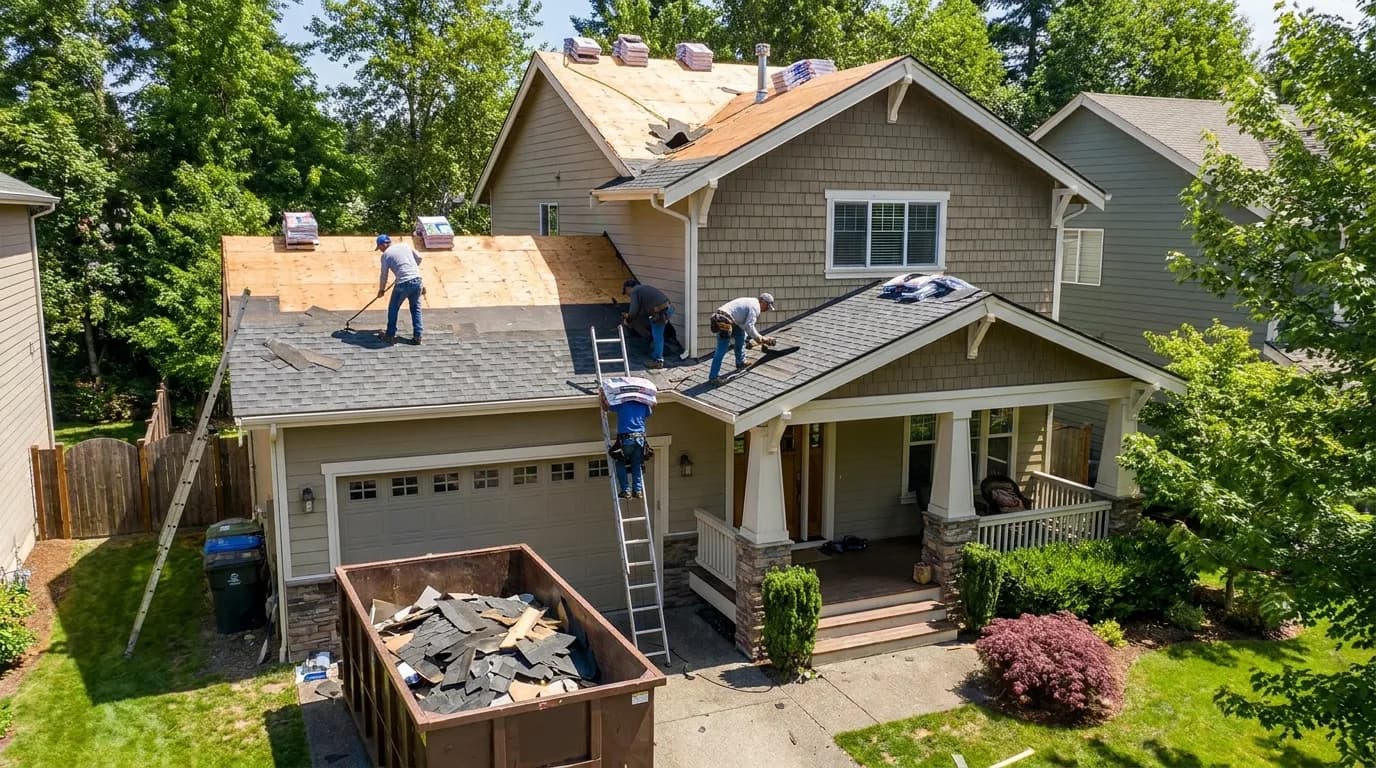
- Old it is removed and the deck edge inspected for rot before any new metal goes on.
- Eave metal is installed first, on the bare deck, with the ice and water shield lapped over it.
- Rake metal goes over the underlayment and overlaps the eave metal at each corner.
- Joints lap 50 mm or more in the direction of water flow and are not smeared with caulking, which traps water.
- Nails go through the roof flange every 200 to 300 mm, never through the vertical face.
- Corners where the eave meets the rake are cut and folded, not left open, so wind cannot drive water into the gap.
- The metal lip hangs clear of the fascia by roughly 6 mm, so water drips off rather than running down the board.
- Starter strip is set flush with the drip edge and the first course overhangs it slightly.
If a quote lists the flashing on all eaves and rakes, names the profile and the colour, you are looking at a crew that takes the edges seriously. If the flashing is not on the quote at all, ask why. Our post on how long a roof replacement takes walks through where this step falls in the day.
How much does it cost in Alberta?
Drip edge is cheap relative to everything else on a roof. The figures below are rough Alberta market guides as of 2026, not quotes, and they move with metal prices and with how much fascia repair turns up once the old metal comes off.
| Item | Rough guide (CAD) | Notes |
|---|---|---|
| Aluminum Type C or D drip edge, material only | $1 to $3 per linear foot | Sold in 10 ft lengths at building supply stores |
| Steel or pre-painted the flashing, material only | $2 to $4 per linear foot | Stiffer; colour-matched options |
| Gutter apron, material only | $2 to $5 per linear foot | Longer face uses more metal |
| Installed as part of a full reroof | $2 to $5 per linear foot | Labour is minimal because the deck is already open |
| Retrofit on an existing roof, eaves only | $5 to $10 per linear foot | Shingles must be lifted; brittle shingles may crack |
| Typical Airdrie two-storey, 150 to 250 linear feet of edge | $300 to $1,000 installed on a reroof | Add fascia repair if rot is found |
On a reroof, most Airdrie homes land somewhere between $300 and $1,000 for all eaves and rakes. Retrofitting it under an existing shingle roof is possible on the eaves but often not worth it on older shingles, because lifting them cracks the tabs. If your roof has a few years left, plan the it for the next replacement and keep the fascia painted in the meantime. Get a free on-site quote for an exact figure.
How to check your drip edge from the ground
You do not need a ladder to get a good idea of whether your roof has the flashing. Stand at a corner of the house where an eave meets a rake and look up at the edge of the roof with binoculars or a phone camera on zoom.
- At the eaves: Look between the shingle edge and the eavestrough. You should see a strip of metal, usually white or brown, tucked under the shingles and hanging down behind the trough. Bare plywood, a dark shadow line or shingles sagging into the trough means no drip edge.
- At the rakes: Along the gable edge, look for a metal edge under the shingles running up the slope. If the shingle edge looks ragged or the underlayment is visible, there is no rake metal.
- Fascia condition: Peeling paint, dark staining along the top of the fascia or water marks behind the eavestrough are classic signs of missing or badly installed it.
- Icicles: In winter, icicles forming behind the eavestrough rather than off its front lip suggest water is getting behind the trough, which the flashing or gutter apron would stop.
If you are unsure, a free roof inspection in Airdrie will confirm it, along with the state of the fascia and the first course of shingles. It is a five-minute check for a roofer on a ladder, and it often explains a fascia problem that has been blamed on the eavestroughs.
Getting the edges right on your next roof
Drip edge is a small detail with an outsized effect on how long your fascia, deck edge and eavestroughs last. Under at the eaves, over at the rakes, Type D or gutter apron on the eaves, lapped and nailed properly, and coordinated with any new eavestroughs. That is the whole recipe.
When you compare quotes for a new roof, look for the flashing as a named line item on every edge, alongside ice and water shield, starter strip and ventilation. Our pillar guide to the best shingles for Alberta's climate explains why those accessories matter more than the brand on the shingle wrapper.
Apex Roofing Airdrie includes it on every eave and rake as standard and lists it on the itemised written quote so you can see it. If you want to know whether your current roof has any, book a free, no-obligation on-site estimate and we will check the edges, the fascia and the rest of the roof while we are there.
Written by the Apex Roofing Airdrie crew
Practical guidance from the local roofers who inspect, repair and replace roofs across Airdrie and Rocky View County every season. We review our guides against current Alberta practice and update them when materials, code or insurer behaviour changes. About our team.