In this guide
- 01What is a chimney cricket? The chimney saddle definition
- 02How a chimney cricket works
- 03Signs your chimney needs a cricket: width, pitch and standing water
- 04Chimney cricket code requirements: the 30-inch rule
- 05What happens without a chimney cricket: leaks, ice and rot in an Alberta winter
- 06Chimney cricket flashing: step flashing, counterflashing and membrane
- 07How a chimney cricket is built and installed
- 08Chimney cricket cost in Airdrie and Calgary: a 2026 guide
- 09Hail and Chinook wind: why Alberta crickets take more abuse
- 10Is chimney cricket repair covered by insurance?
- 11Adding a cricket during a full reroof vs as a standalone retrofit
- 12When to call a professional
What is a chimney cricket? The chimney saddle definition
A chimney cricket is a small, peaked, roof-shaped structure built on the uphill (high) side of a chimney, ridge vent, skylight curb or any other obstruction that is wide enough to dam water and snow moving down the slope. It is also called a chimney saddle, because it sits behind the chimney the way a saddle sits behind a horse's shoulders, splitting the flow of water into two channels that run around the sides of the chimney instead of pooling against it.
Picture a roof sloping down toward the eaves with a masonry chimney stack sitting across that slope partway up. Everything above the chimney, on a wide enough chimney, has nowhere to drain but straight into the back of it. A cricket is a two-sided miniature roof, framed with its own ridge and two short slopes, that catches that water and sheds it left and right around the chimney's sides.
Crickets are built from framing lumber or plywood, then flashed and shingled (or membraned) to match the surrounding roof. On a well-built one you should barely notice it; it reads as a small kink in the roofline right behind the chimney, not as an obvious add-on. Most homeowners only learn the word chimney cricket exists when a roofer points to the flat, damp patch behind their chimney and explains why it needs one. Roofers and building inspectors sometimes just call it a roof cricket, or a saddle, but all three names describe the same structure.
How a chimney cricket works
The physics behind a chimney cricket are simple. Water and melting snow move downhill under gravity. A chimney sitting across the slope acts like a dam: on a narrow chimney the water simply splits around the sides on its own, but on a wide chimney the area directly above it is flat enough, and the chimney wide enough, that water backs up and sits there instead of finding a way around.
A cricket's ridge line runs perpendicular to the chimney's face and meets the roof at an angle, so it redirects flow the moment it reaches the obstruction rather than letting it collect first. The two short slopes of the cricket are usually built at the same pitch as the main roof, or slightly steeper, so water and melting snow keep moving instead of slowing down and refreezing.
Flashing does the rest of the work at the actual joints. The cricket's own valleys, where its two slopes meet the main roof, need the same valley flashing or membrane as any other roof valley. Where the cricket meets the chimney itself, step flashing and counterflashing tie it in, the same materials used around the rest of the chimney. A cricket without proper flashing at these joints is really just a shaped piece of wood; the flashing is what actually stops the water, and our guide to roof flashing repair around chimney leaks covers those same materials in more detail.
Signs your chimney needs a cricket: width, pitch and standing water
Three things push a chimney toward needing a chimney cricket: how wide it is across the slope, how shallow the roof pitch is, and how much water the roof above it sheds. A narrow chimney on a steep roof rarely needs one, because water clears the sides quickly on its own. A wide chimney on a low-slope roof is the classic case, because water has both more chimney to get around and less gravity helping it along.
The most reliable sign from the ground or a ladder is standing water or debris behind the chimney after a rain. Look for a dark stain on the shingles just uphill of the chimney, moss or algae growth in that one spot when the rest of the roof is clean, or a small pile of granules, needles and leaves that never seems to wash away. In winter, that same flat spot is where snow sits longest and where ice tends to build first.
- Chimney width: wider chimneys catch and hold more water; this is the main trigger discussed in the code section below.
- Roof pitch: the lower the slope, the more likely water pools instead of shedding around the sides.
- Visible staining or algae on the shingles directly above the chimney.
- Debris buildup (needles, leaves, granules) that collects and stays wet behind the chimney.
- Ice or snow that lingers behind the chimney well after the rest of the roof has cleared.
- A ceiling stain or attic leak near the chimney chase, which often means the cricket flashing has already failed or was never installed.
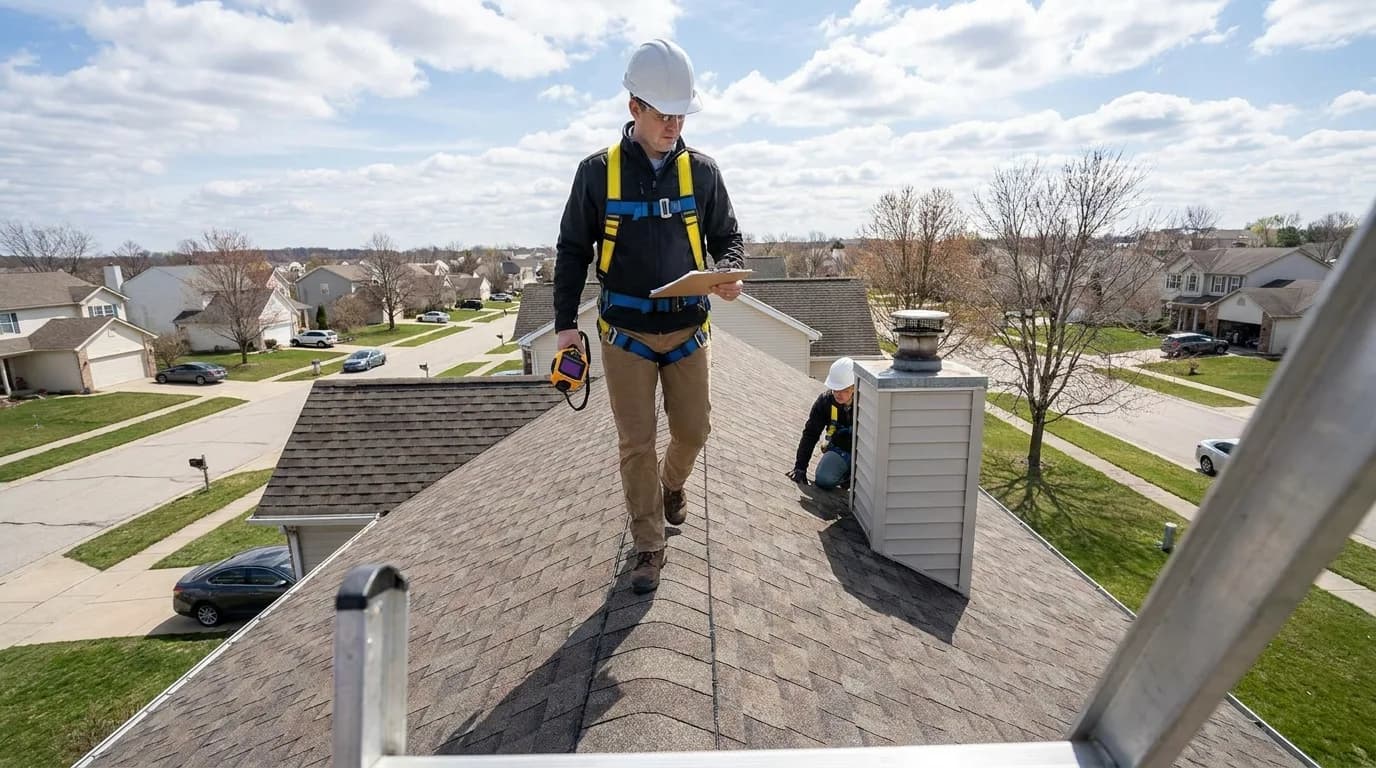
Any one of these on its own is worth a look. Two or three together, especially on a chimney that looks wide relative to the roof, is a strong hint that a cricket was skipped when the roof or chimney was built. A chimney check like this belongs on a seasonal walk-around; our Alberta roof maintenance checklist includes it alongside the eavestrough and attic checks most homeowners already do.
Chimney cricket code requirements: the 30-inch rule
Chimney cricket code requirements across North America commonly trigger at the same point: once a cricket, or an equivalent saddle flashing arrangement, once a chimney measures 30 inches (about 76 cm) or more across the roof slope, measured parallel to the ridge. Below that width, most codes consider standard step flashing and counterflashing sufficient because the chimney is narrow enough that water clears around it without pooling.
That 30-inch figure comes from residential building code language widely used across North America, and it shows up consistently in manufacturer and industry guidance. Alberta follows the National Building Code as adapted through the Alberta Building Code, and the City of Airdrie applies that code through its own permitting process, so the exact wording, thresholds and any local amendments should be confirmed with the City of Airdrie or your municipality's building department before you treat 30 inches as a hard, universal number for your specific project.
In practice, the code requirement matters most in two situations: building a new chimney or reroofing a home where the existing chimney has always leaked because a cricket was never built, and adding a permit-triggering renovation where an inspector may flag a wide chimney without one. If you are unsure whether your chimney crosses that threshold, a tape measure across the chimney's width, compared against 30 inches, is the fastest first check, followed by a professional opinion if you are close to the line.
What happens without a chimney cricket: leaks, ice and rot in an Alberta winter
Skipping a needed cricket does not usually cause an immediate leak. It causes a slow, cumulative one, and that is what makes it dangerous. Water and melting snow collect behind the chimney every time it rains or thaws, and even well-installed step flashing is only designed to shed water moving past it, not to hold back a standing pool.
Over one or two Alberta winters, the pattern becomes familiar. A Chinook melts the snow sitting behind the chimney, the meltwater has nowhere to drain quickly, and as temperatures drop again overnight it refreezes right at the flashing joint. That freeze-thaw cycling, repeated many times across a Calgary-area winter, works ice into every seam in the flashing and slowly pries it away from the chimney and the shingles. A joint that was well sealed when the roof was new can be visibly lifted a few winters later.
Once water gets past the flashing, it soaks the roof sheathing directly behind the chimney, which is exactly the area a cricket exists to protect. Sheathing rot in that spot is expensive to fix because it usually is not discovered until either a ceiling stain shows up inside or a roofer pulls back the shingles during a reroof and finds soft, discoloured plywood. Left long enough, the rot spreads to the rafters, and by then you are looking at structural framing repair, not just flashing.
Chimney cricket flashing: step flashing, counterflashing and membrane
A chimney flashing cricket only works as a system, and that system has three parts working together. Step flashing is a series of small L-shaped metal pieces, one per shingle course, that runs up both sides of the chimney and along the cricket's edges, each piece overlapping the one below it so water is always shed downward and outward.
Counterflashing is the second layer, typically cut into a mortar joint in the masonry (or under a reglet in some construction) and folded down over the top of the step flashing. This is what keeps water from getting behind the step flashing where it meets the chimney itself, and it is usually the piece that looks the most obviously "built" from the ground, since it traces the chimney's outline.
On the cricket's own valleys, where its two small slopes meet the main roof, self-adhering ice-and-water shield membrane is standard practice before the metal or shingles go on. In Alberta this membrane matters more than in milder climates, because it is the last line of defence if ice does form at that joint during a freeze-thaw cycle. Whether the finished cricket surface is shingled to match the roof or clad in metal is mostly an aesthetic and durability choice, but the membrane and step-and-counterflashing underneath should never be skipped regardless of the surface finish.
How a chimney cricket is built and installed
Framing comes first. A carpenter or roofer builds a small triangular or two-slope frame from dimensional lumber or plywood gussets, sized to the chimney's width and set at a pitch that matches or slightly exceeds the main roof. The frame sits on top of the existing roof deck, fastened securely into the structure below, with its ridge centred behind the chimney and its two slopes running down to meet the main roof on either side.
Sheathing goes over the frame next, typically plywood or OSB matching the rest of the roof deck, cut to follow the cricket's two small planes. Once the sheathing is in place, the membrane and flashing sequence described above goes on: ice-and-water shield in the valleys, step flashing up both sides against the chimney, and counterflashing cut into the masonry or tied into the chimney chase covering.
The final surface, whether asphalt shingles matching the field of the roof or a metal cricket cap, gets installed last, woven into the surrounding shingle courses so there is no visible seam where the cricket meets the main roof. A cricket built this way should be indistinguishable in appearance from the rest of the roof once finished, with the only clue being the slight ridge line running back from the chimney.
Chimney cricket cost in Airdrie and Calgary: a 2026 guide
Chimney cricket cost depends heavily on whether it is being built as part of a full reroof or added afterward as a standalone retrofit, and on the chimney's width and the roof's pitch and material. The figures below are a rough 2026 Alberta market guide in CAD, not a quote; every roof and chimney is different, and only an on-site look gives you a real number.
| Scenario | What is involved | Rough 2026 cost (guide) |
|---|---|---|
| Cricket built during a full reroof | Framing, sheathing, membrane, flashing and shingles added while the roof is already open | $300-$800 added to the reroof |
| Standalone cricket retrofit | Removing shingles around the chimney, framing, flashing and re-shingling a small area | $600-$1,800 |
| Cricket flashing repair only (existing cricket, failed flashing) | Re-flashing step and counterflashing without rebuilding the frame | $400-$1,200 |
| Complex or oversized chimney (wide chase, steep pitch, difficult access) | More framing, more flashing runs, more labour time | $1,800-$3,500+ |
Adding a cricket during a scheduled reroof is almost always the cheaper path, because the roofer is already removing shingles, exposing the deck and staging the ladders and materials for the whole job. A standalone retrofit costs more per square foot of work because it means opening up a small, isolated section of an otherwise intact roof, matching shingle courses, and often re-flashing more of the chimney than the cricket itself to get a clean tie-in.
Hail and Chinook wind: why Alberta crickets take more abuse
Airdrie sits in what is often called Alberta's Hailstorm Alley, and a cricket's metal flashing and shingled surface are directly exposed to whatever falls from the sky. Storms like the Aug 8, 2026 Crossfield-Airdrie hailstorm, which brought quarter-sized hail and strong wind, can dent or split cricket flashing and crack the solder or sealant at its joints the same way hail damages the rest of a shingle roof. Because a cricket is small and sits in a slightly recessed spot behind the chimney, hail damage there is easy for a homeowner doing a ground-level check to miss entirely.
Chinook winds add a second kind of stress that most of Canada does not deal with. A rapid Chinook thaw can send temperatures from well below freezing to above zero in a matter of hours, melting snow sitting on and around the cricket, only for the next cold snap to refreeze that meltwater within a day or two. Airdrie can see several of these freeze-thaw swings in a single winter, each one working at any gap in the flashing sealant and each one testing whether the cricket's membrane is doing its job.
The combination is why a cricket that would last far longer in a milder, drier climate can start showing flashing problems much sooner here. It is also why a hail or windstorm claim is a natural moment to have a roofer check the cricket specifically, rather than assuming that because the shingles look fine from the ground, the flashing behind the chimney escaped unscathed.
Is chimney cricket repair covered by insurance?
Whether a damaged or failed chimney cricket is covered depends on the cause and the specifics of your policy, so this should always be confirmed with your insurer or broker rather than assumed. Sudden, identifiable storm damage, such as a hailstorm denting or cracking cricket flashing, is the kind of damage insurance is generally designed to respond to, in the same way it responds to hail damage anywhere else on the roof.
Where it gets more complicated is when the cricket was never built to begin with, or when its flashing has failed gradually over years of freeze-thaw cycling rather than from one identifiable storm event. Insurers typically distinguish between sudden and accidental damage and gradual wear, maintenance or original construction deficiencies, and a missing cricket that should have been there since the roof was built often falls into that second, less clearly covered category.
If you are filing a hail or wind claim and you know or suspect the chimney lacks a cricket, or that its flashing has been damaged, it is worth having your roofer document that specifically as part of the roof insurance claim documentation and support in Airdrie process. A clear photo record and a written scope that separates storm damage from any pre-existing condition gives the adjuster the clearest picture and gives you the best chance of getting the repair, or the cricket itself, included in the approved scope of work. Alberta homeowners considering this route should also read our pillar guide on signs you need a new roof, since chimney flashing problems are one of the signs covered there.
Adding a cricket during a full reroof vs as a standalone retrofit
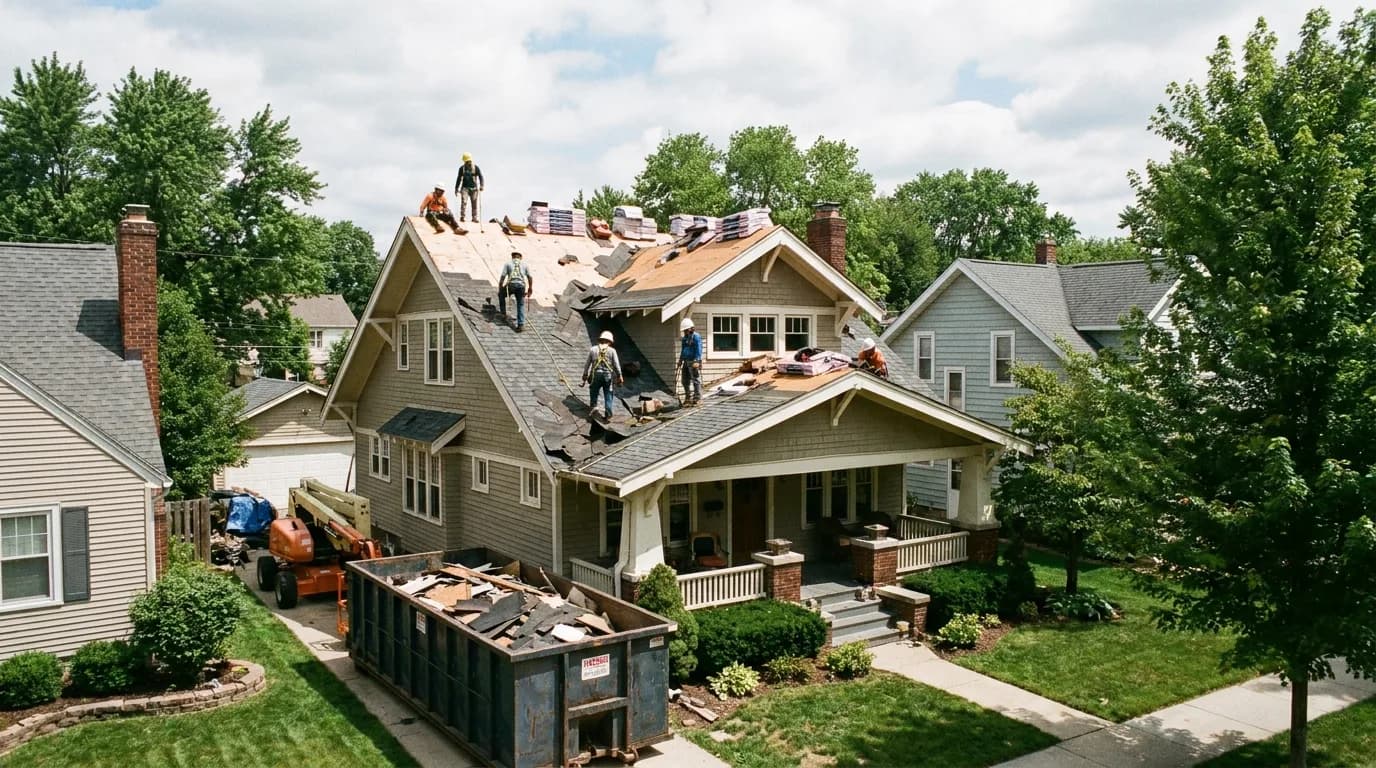
If your roof is due for replacement anyway, or close to it, adding a cricket at the same time is almost always the better financial and practical decision. The roof deck is already exposed, the crew is already staged with the right materials, and the incremental cost of framing and flashing a cricket while everything else is open is a fraction of what it costs to do the same work in isolation later. Our roof replacement service in Airdrie covers exactly this kind of coordination, tying flashing detail work like a chimney cricket into the overall reroof scope.
A standalone retrofit still makes sense when the rest of the roof is in good shape and only the chimney area is causing problems, particularly if you have already seen a leak or a persistent damp patch and do not want to wait years for a full reroof to fix it. In that case the job is more surgical: a roofer opens up just the section around the chimney, builds and flashes the cricket, and re-shingles that area to blend with the rest of the roof.
The decision usually comes down to roof age and how urgent the leak risk is. A roof with 10 or more years of remaining life and no active leak can reasonably wait and have the chimney cricket added at the next reroof. A roof already showing staining, active leaking, or sheathing softness behind the chimney should not wait, because every additional freeze-thaw cycle is doing more damage to the deck underneath.
Timing matters too. Framing, membrane and shingle work all need workable temperatures, so cricket work in the Airdrie area is generally scheduled from spring through fall. Asphalt shingles need warmth to seal properly and self-adhering membrane bonds poorly in the cold, so a cricket problem discovered in the dead of winter is usually handled with a temporary flashing repair, with the permanent cricket built once the weather turns. A homeowner who spots the warning signs in autumn is generally better off booking early rather than losing that window until spring.
When to call a professional
A chimney cricket sits at the intersection of framing, roofing and flashing work, and it is not a project most homeowners should attempt themselves. Cutting into a chimney's mortar joints for counterflashing, tying new framing into an existing roof structure, and getting the membrane and step flashing sequence right all require experience most people only get from doing dozens of these details, not one.
Call a professional if you notice any of the warning signs covered earlier: a stain or algae patch behind the chimney, standing water or lingering snow in that spot, or an interior ceiling stain near the chimney chase. It is also worth a professional look any time you are having a wide chimney built or a roof reroofed, simply to confirm whether your chimney's width crosses the code threshold for a cricket in the first place.
Apex Roofing Airdrie provides a free, no-obligation on-site estimate that includes checking chimney flashing and cricket condition as part of a full roof assessment, with an itemised written quote for whatever work is actually needed. If you suspect hail or wind has already damaged an existing cricket, our roof repair service in Airdrie and roof inspection service in Airdrie are the right starting points, and if permits or code questions come up along the way, our guide to roofing permits in Airdrie and Alberta explains how that process generally works.
Written by the Apex Roofing Airdrie crew
Practical guidance from the local roofers who inspect, repair and replace roofs across Airdrie and Rocky View County every season. We review our guides against current Alberta practice and update them when materials, code or insurer behaviour changes. About our team.