In this guide
- 01Roof inspection cost in Canada: what you actually pay
- 02Why many roofers, including Apex, inspect free, and the honest catch
- 03What do roof inspectors look for? The full checklist
- 04The attic side of a roof inspection
- 05Drone roof inspection versus walking the roof
- 06When do you need a roof inspection?
- 07What the written report should contain
- 08Red flags: when a roof inspection is really a sales pitch
- 09Roof inspection in Calgary and Airdrie: the local factors
- 10Book an inspection, then judge the report
Roof inspection cost in Canada: what you actually pay
Roof inspection cost depends on who does it and why. A roofing contractor usually inspects for free because it leads to a quote. An independent inspector, a home inspector or a drone operator charges for their time. Certified inspections for insurance or a real estate transaction cost the most because they come with a formal report and, sometimes, a signature someone is relying on.
| Type of roof inspection | Rough 2026 cost guide (Alberta) | Best for |
|---|---|---|
| Roofing contractor inspection and estimate | Free from most contractors, including Apex | Repair or reroof decisions, post-storm checks |
| Independent roof inspector | $150–$300 | A second opinion with no sales interest |
| Home inspector roof add-on | $75–$200 on top of the home inspection | Pre-purchase, usually from the ground or a ladder |
| Drone roof inspection | $150–$400 | Steep, high or unsafe roofs, documentation |
| Certified or insurance roof inspection | $250–$400+ | Insurer-requested condition reports, older roofs |
| Infrared or moisture survey (flat roofs) | $300–$600 | Finding wet insulation under a membrane |
These are rough market guides for Alberta as of 2026, not quotes, and prices in the Calgary and Airdrie area sit near the middle of the national range. What matters more than the fee is whether the inspection is thorough and whether the report is something you can act on. The next sections explain what that looks like.
Why many roofers, including Apex, inspect free, and the honest catch
Roofing contractors do free inspections because a careful look at the roof is the first step of any estimate. Apex Roofing Airdrie offers a free roof inspection in Airdrie as part of a no-obligation on-site estimate, and most reputable local companies do the same. It costs us an hour and a set of photographs, and it means the quote we write is based on the roof rather than a guess.
The honest catch is that a free inspection is also a sales visit. The person on your roof would like to do the work, and a small minority of companies use the visit to find problems that are not there, or to declare a repairable roof finished. Storm-chasing outfits that appear after hail are the worst for this, and our guide to roofing scams and storm chasers in Alberta explains the warning signs.
So the rule is simple: judge the report, not the price. A free inspection that gives you dated photographs of every slope, names the specific problems and their locations, tells you what does not need fixing, and puts repair and replacement options side by side is worth more than a paid one that produces a two-line summary. If a free inspection produces only a verbal "you need a new roof", pay for a second opinion before signing anything.
What do roof inspectors look for? The full checklist
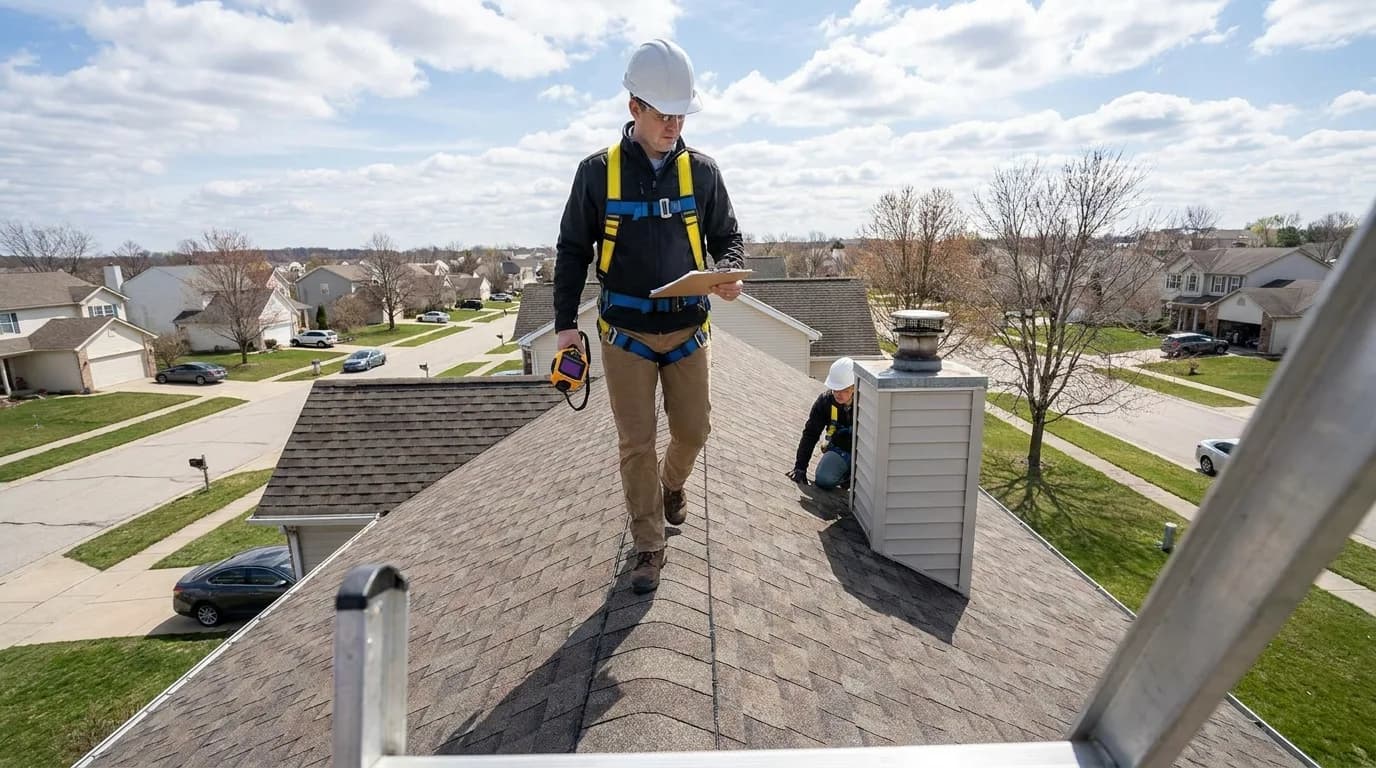
A proper roof inspection is a systematic walk of the whole roof, not a glance from the ladder. Here is what a competent inspector checks, roughly in the order they check it.
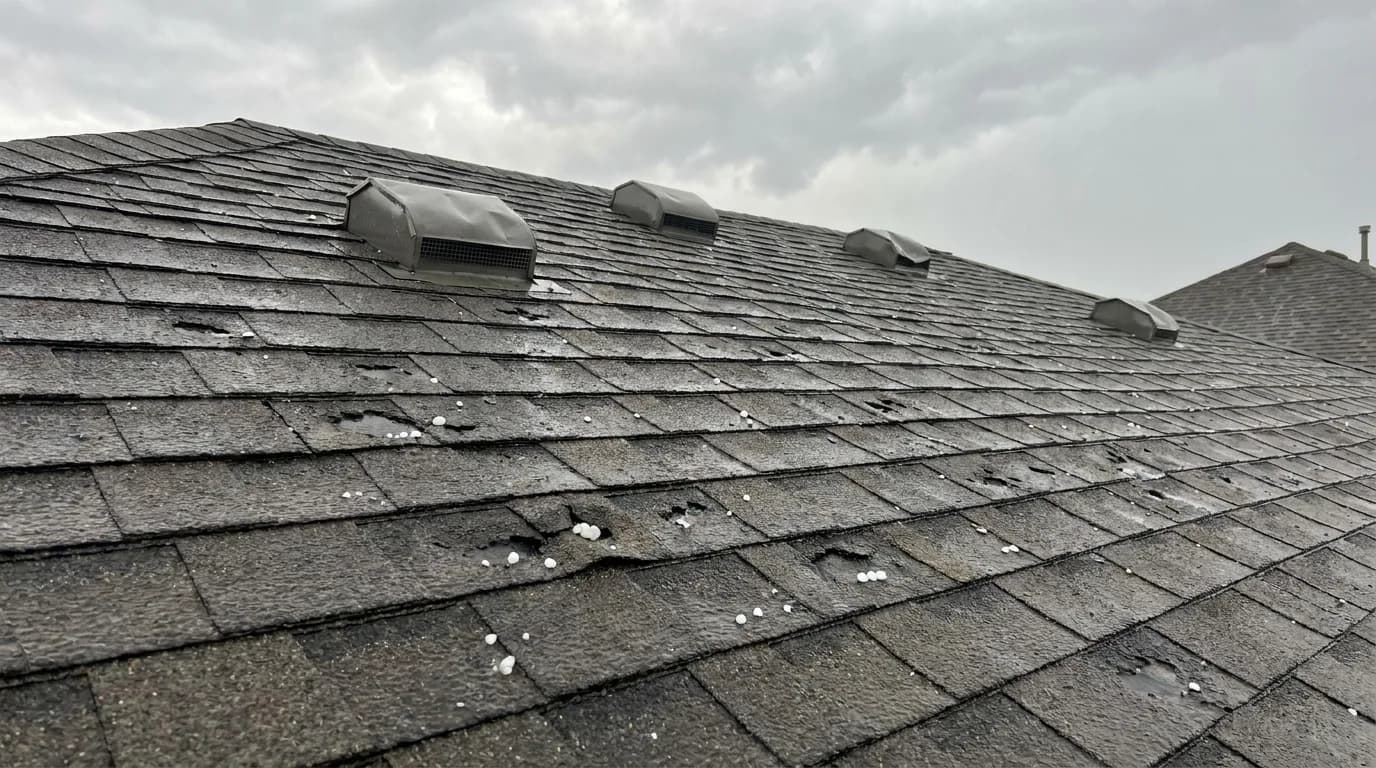
- The shingle field: granule loss, bruising and cracks from hail, curling, cupping, blistering, missing or lifted tabs, exposed nail heads, and the condition of the seal strip.
- Flashing: chimney step and counter flashing, wall flashings, kick-out flashing at eave-to-wall junctions, and whether any of it is lifted, rusted, cracked or relying on caulking alone.
- Penetrations: plumbing stack boots, furnace and hot water flues, bathroom and kitchen exhaust hoods, satellite mounts and solar attachments. Cracked rubber boots are one of the most common leak sources in Airdrie.
- Soft metals: roof vents, drip edge, eavestroughs and downspouts, checked for hail dents that confirm storm size and direction.
- Valleys: whether they are open metal or closed-cut, debris build-up, wear at the centreline, and signs of water tracking under the shingles.
- Eaves and rakes: drip edge, starter strip, ice-and-water shield extent (visible in the attic), fascia rot and evidence of past ice dams.
- Ridge and hips: ridge cap condition, ridge vent attachment, and cracked or blown-off caps.
- Skylights: glazing seals, curb flashing, cladding, and staining inside around the well.
- Decking: soft spots underfoot, delaminated OSB, sagging between trusses and nail pops that telegraph through the shingles.
An inspector who does not physically walk the roof, or fly it, cannot check most of this. If you are getting a roof inspection before buying a house in Airdrie, ask specifically whether the roof will be walked or only viewed from the ground.
The attic side of a roof inspection
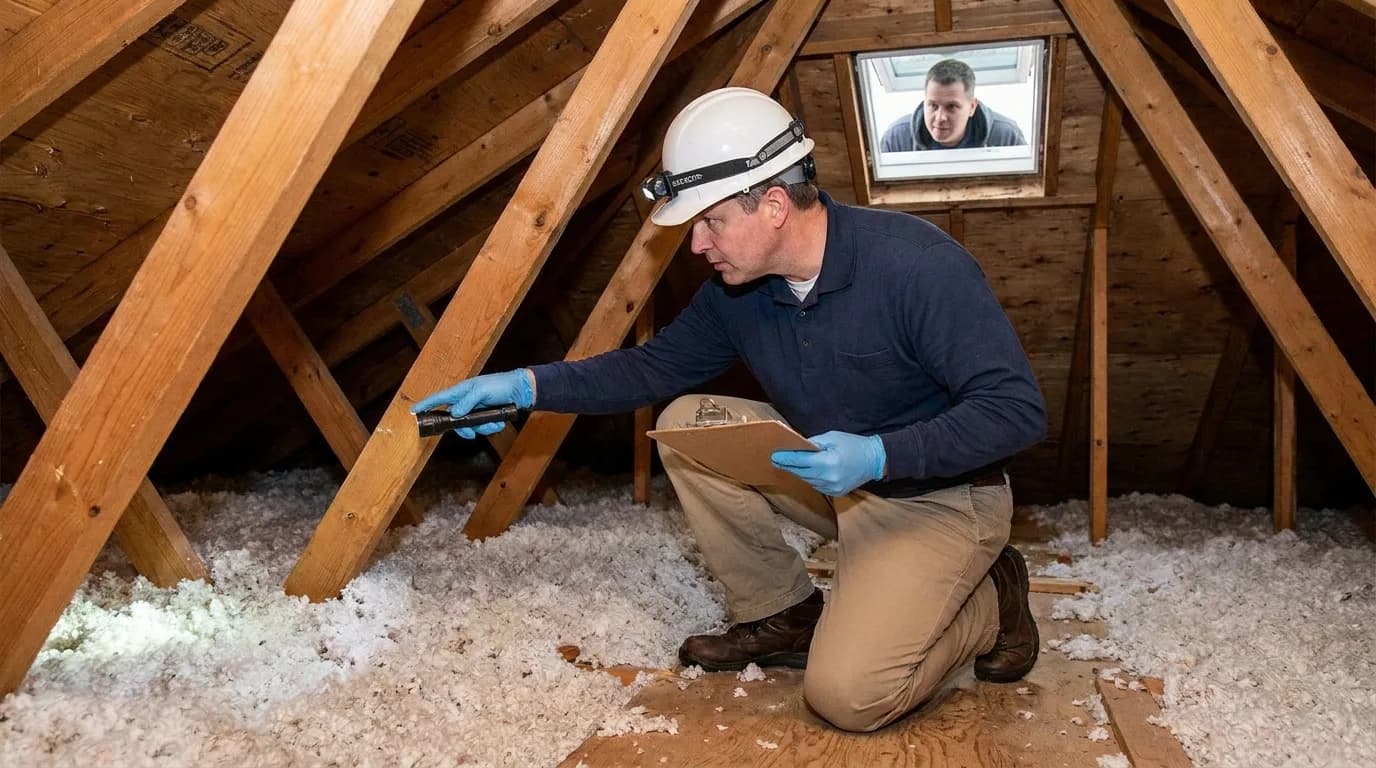
Half of what matters about a roof is only visible from underneath. A thorough inspection includes the attic, and it is a fair test of an inspector: if they never ask where the hatch is, the inspection is incomplete.
From inside, an inspector looks for daylight through the deck, water staining on the underside of the sheathing, rusted nail tips, frost or condensation in winter, mould, wet or compressed insulation, and the actual extent of ice-and-water shield at the eaves. They check that bathroom fans are ducted outside rather than dumping into the insulation, that the soffit vents are not blocked by insulation, and that there is a reasonable balance of intake and exhaust ventilation.
Ventilation matters because a hot, poorly vented attic ages shingles from below and feeds winter ice dams. The commonly cited requirement is 1:300 net free vent area to attic floor area, or 1:150 without a vapour barrier, and the inspection should say whether your attic is close. Our guide to attic ventilation and roof vents in Alberta explains how to do a basic check yourself.
Drone roof inspection versus walking the roof
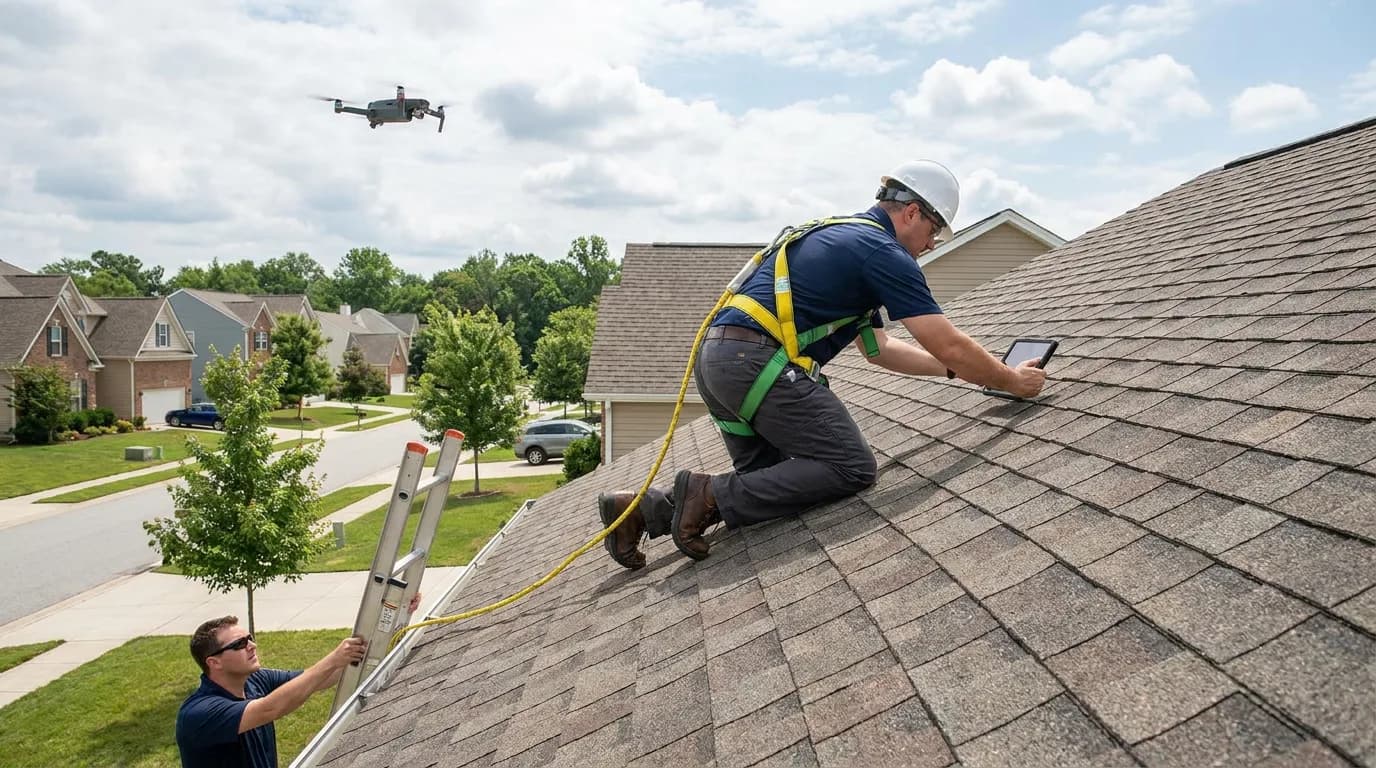
Drone roof inspection has become common in Alberta, and for good reason. A drone can survey a steep, high or ice-covered roof safely, it captures every slope in consistent high-resolution images, and the photographs make excellent documentation for an insurance file. For a large, complex roof it is faster than walking, and it avoids putting feet on brittle 25-year-old shingles.
What a drone cannot do is touch the roof. It cannot lift a shingle tab to check the seal strip, press on the deck to find a soft spot, feel whether a hail bruise has cracked the mat, or look under a flashing. It cannot see the attic. For hail assessment in particular, photographs show granule loss but often miss the bruising that an adjuster will test by hand, which is explained in our guide on how to tell if your roof has hail damage.
The best inspections combine the two: a drone or a camera pole for the overview and the documentation, and a walk for the detail where the roof is safe to walk. If a company offers only a drone flight and a quote, ask whether they will also get on the roof, or at least the ladder, before the work is priced.
When do you need a roof inspection?
Not every roof needs an annual professional look, but there are moments when an inspection pays for itself many times over.
| Situation | Why it matters | Timing |
|---|---|---|
| After a hail or wind storm | Damage is often invisible from the ground and many insurers want claims filed within 12 months | Within a few weeks of the storm |
| Before buying a house | Roof age and condition are the biggest single repair risk in an Airdrie purchase | During the conditions period |
| Before listing a house | A known roof condition avoids a mid-deal renegotiation | Before photos are taken |
| Insurance renewal or new policy | Many insurers ask for roof age and condition, especially past 20 years | When the insurer asks |
| Roof age 15 years or more | Sealant, flashing and granule loss start to show; catching them early is cheap | Every one to two years |
| After an ice dam or a known leak | Water may have damaged decking and insulation | Once the roof is dry |
| Before a solar or satellite installation | Nobody wants to remove panels for a reroof three years later | Before signing the install contract |
The Aug 8, 2026 storm that tracked down the Crossfield–Airdrie corridor with quarter-sized hail is a good example of the first row. Many roofs in northwest Airdrie took hits that will not show as leaks for a year or two, and by then the claim window may have passed. Our hail damage roof repair service includes documentation for the insurer as part of the inspection.
What the written report should contain
Whether the inspection was free or cost $400, the deliverable is the report. Without a written record, an inspection is just an opinion you cannot show to an insurer, a buyer or a second contractor. A proper report includes:
- Dated photographs of every slope, plus close-ups of each problem found, labelled with location (for example "north slope, above the garage").
- A description of the roof: material, approximate age, layers, pitch, square footage, ventilation type.
- Each issue, its severity and its urgency: cosmetic, monitor, repair this season, or repair now.
- What was checked and found sound. An honest report says the flashing is fine as clearly as it says the vents are cracked.
- The attic findings: insulation depth, ventilation, staining, ice-and-water extent.
- Remaining life estimate, with the reasoning, not just a number.
- Options with rough costs: repair versus replace, with the trade-offs.
- Any safety or code notes: missing kick-out flashing, unvented fans, and so on.
A report in that form lets you do something useful with it. You can send it to your broker, attach it to a listing, compare it against a second quote, or file it and check again in two years. Our pillar guide to the signs you need a new roof is a good companion for reading a report and deciding how much weight each finding deserves.
Red flags: when a roof inspection is really a sales pitch
Most inspections in the Airdrie area are honest. The following behaviours, particularly after a storm, are signs that you are being sold rather than informed.
- A verbal verdict with no report or photographs, or photographs that could be of any roof.
- Pressure to sign the same day, often tied to a "storm discount" or a claim deadline that does not exist.
- A request to sign an assignment of benefits or a contingency agreement before you have seen what they found.
- Every roof on the street "needs replacement" regardless of age or condition.
- Refusing to price a repair on a roof that is under 15 years old and damaged in one area.
- Offers to cover your deductible, which is insurance fraud in Alberta and can void your claim.
- No local address, no licence, out-of-province plates, and a company name you cannot find on the Alberta corporate registry.
Alberta homeowners choose their own contractor on an insurance claim, so there is never a reason to sign with the first person who knocks. Get the report, get a second inspection if the first one recommends a full replacement, and then decide.
Roof inspection in Calgary and Airdrie: the local factors
Roof inspection in Calgary, Airdrie and the surrounding towns has one focus that inspectors elsewhere in Canada rarely share: hail. This corridor sits in Alberta's Hailstorm Alley, and according to the Insurance Bureau of Canada, Alberta has recorded a major hailstorm every year for two decades, with more than $11 billion in insured damage over that period. A local inspector reads soft metals, granule patterns and directional bruising the way a coastal inspector reads moss.
The other local factors are Chinook freeze-thaw cycles, which fatigue sealant strips and flashing, prairie wind that lifts tabs on the west and north slopes, long UV summers that bake south slopes, and heavy snow that tests eaves and ventilation. A good inspection in this area checks each slope with those specific stresses in mind, and the report should say which slope is ageing fastest and why.
Age also plays into insurance here more than most homeowners expect. Many insurers become cautious once a roof passes about 20 years, and some ask for a condition report before renewing. An inspection with a clear remaining-life estimate can be the difference between a straightforward renewal and a scramble. Regular roof maintenance in Airdrie every year or two keeps that report on file and keeps small problems small.
Book an inspection, then judge the report
If your roof is past 15 years, has been through a storm, or is part of a purchase or sale, get it inspected. Apex Roofing Airdrie inspects for free as part of a no-obligation on-site estimate, walks the roof and the attic, photographs every slope, and gives you an itemised written report and quote you can compare against anyone else's. If the roof does not need work, the report says so.
Prefer an independent paid inspection first? That is a sensible choice, and we are happy to quote against it. Either way, the goal is the same: a clear picture of where your roof stands, and a plan that fits, whether that is a small repair, a season of monitoring, or a reroof timed before the next hail year rather than after.
Written by the Apex Roofing Airdrie crew
Practical guidance from the local roofers who inspect, repair and replace roofs across Airdrie and Rocky View County every season. We review our guides against current Alberta practice and update them when materials, code or insurer behaviour changes. About our team.