In this guide
- 01What a roof heat cable does, and what it does not
- 02Self-regulating vs constant-wattage heat cable
- 03Where heat cables go: eaves, valleys, eavestroughs and downspouts
- 04Do roof heat cables work? What to expect in practice
- 05What a roof heat cable costs to run: the arithmetic
- 06Heat cable installation cost: DIY vs professional
- 07Fire, GFCI and electrical safety
- 08When heat cable makes sense in Airdrie, and when it is a bandage
- 09The real fix: air sealing, insulation and ventilation
- 10Get the ice dam problem diagnosed before you buy cable
What a roof heat cable does, and what it does not
A roof heat cable, also sold as heat tape for roof edges or roof de-icing cable, is a low-wattage electric heating wire clipped to the shingles above the eaves and run through the eavestroughs and downspouts. When it is powered, it warms a narrow strip of roof to just above freezing so meltwater has a path off the roof instead of freezing at the edge.
That is the whole trick, and it is worth being clear about what it means. Heat cable does not warm the roof deck. It does not stop snow melting higher up the slope where the attic is leaking heat. It does not remove an ice dam that has already formed across the whole eave. What it does is keep channels open through the ice so the water behind the dam can drain rather than pool and back up under the shingles. Managed, not cured.
For a lot of Airdrie homes that is still valuable. Older bungalows in Big Springs or Thorburn with shallow attics, bonus rooms over garages in Kings Heights and Sagewood, and north-facing valleys that never see sun are the roofs where ice dam heat cable earns its keep. The rest of this guide covers how to choose it, place it, power it and pay for it, and when to skip it in favour of the real fix.
Self-regulating vs constant-wattage heat cable
There are two kinds of cable on the shelf and they behave very differently. Constant-wattage cable, the budget option sold in fixed lengths at hardware stores, puts out the same heat per metre whether it is minus 30 or plus 5, whether it is buried in ice or lying on a dry shingle in April. Self-regulating cable uses a conductive polymer core that draws more current as it gets colder and less as it warms, so it throttles itself along its length.
| Feature | Constant-wattage cable | Self-regulating cable |
|---|---|---|
| Heat output | Fixed, typically 5–7 W/ft | Varies with temperature, roughly 5–8 W/ft when cold, much less when warm |
| Length | Fixed kits (cannot be cut) | Cut to length on site, spliced with kits |
| Overlap or touching itself | Overheats; a fire risk | Safe; self-limiting |
| Control | Must use a thermostat or timer | Works without one but a controller cuts running cost |
| Lifespan | 3–5 winters typical | 10+ winters typical |
| Rough 2026 material cost (guide) | $2–$4 per foot | $6–$14 per foot plus end kits |
For a permanent installation on an Alberta roof, self-regulating cable is the better product almost every time. It survives the overlaps at corners and downspout drops that would overheat constant-wattage cable, it can be trimmed to the exact run, and it costs less to operate over a winter. Constant-wattage kits are a reasonable one-season stopgap on a small eave if you accept the shorter life and run them on a thermostat.
Where heat cables go: eaves, valleys, eavestroughs and downspouts
Placement decides whether the cable works. The standard layout is a zigzag along the eave, with the peaks of the zigzag reaching about 30 to 45 cm past the exterior wall line so the channel starts on the warm part of the roof, and the troughs dropping into the eavestrough. Spacing is usually 60 cm between peaks on a normal pitch, tighter on a low slope.
- Eaves: zigzag pattern clipped to the shingles with the manufacturer's clips, never nailed through the cable.
- Valleys: a single run up each side of the valley to a point above where ice normally forms, because valleys concentrate meltwater and dam readily.
- Eavestroughs: a straight run along the bottom of the trough the full length of the heated eave, so the channels drain into open trough rather than a frozen one.
- Downspouts: a loop down every downspout on the run and back up, or a single drop with a weighted end, so the outlet stays open.
- Behind dormers and at wall intersections: extra runs where snow drifts and the roof meets a heated wall.
- Around skylights: sometimes, where a skylight sits low on a slope and dams below it.
The mistake we see most is cable on the eaves with nothing in the trough or downspout. The channels melt, the water reaches a frozen eavestrough and freezes again, and the ice now sits in the trough pulling it off the fascia. If you are having eavestroughs replaced anyway, our eavestrough service in Airdrie can run the cable inside the new trough and downspouts as part of the same job.
Do roof heat cables work? What to expect in practice
Yes, within their limits. A well-placed self-regulating system on a thermostat will keep drainage channels open through a normal Airdrie winter and stop the backup-under-shingles leaks that ice dams cause. Homeowners who have had ceiling stains every February usually see them stop. Icicles shrink to the areas between the zigzag peaks.
What it will not do is make the eaves ice-free or the roof look clear. You will still see ice ridges with melted channels through them, and in a long Chinook cycle with thick snowpack the channels can refreeze faster than the cable clears them. It also does nothing about the reason the snow is melting in the first place, which is why the last section of this guide matters.
If a dam has already formed and water is coming in, cable will not fix it this week. Steam removal or calcium chloride socks are the immediate answers, covered in our post on safe ice dam removal methods and their cost. Install cable after the roof is cleared and dry, and ideally in the fall, not in a January emergency.
What a roof heat cable costs to run: the arithmetic
Running cost is the number people forget. Here is the math for a typical single-eave run on a two-storey, done with rounded figures and labelled as an estimate. Your rate, your control method and the winter itself will move it.
- Cable length: 30 m of self-regulating cable, about 98 ft.
- Draw when cold: 5 to 8 W per foot, so roughly 490 to 790 W, call it 0.5 to 0.8 kW.
- Hours on: with a thermostat that powers the cable only below about 3°C and a snow sensor or timer, perhaps 6 to 10 hours a day for a 120-day winter, so 720 to 1,200 hours.
- Energy: 0.5 kW × 720 h = 360 kWh at the low end; 0.8 kW × 1,200 h = 960 kWh at the high end.
- Alberta all-in cost per kWh: energy plus delivery, transmission and fees typically lands in the range of $0.20 to $0.30 as of 2026 (check your own bill).
- Winter cost: roughly $70 to $290, with most homes in the $100 to $250 band.
Left switched on manually from November to March, 24 hours a day, the same cable could use more than 2,000 kWh and cost $400 to $600. The controller pays for itself in the first winter. Because self-regulating cable throttles back as it warms, real draw is usually lower than the cold-weather figure, which is another reason to prefer it over constant-wattage.
Heat cable installation cost: DIY vs professional
As a rough 2026 guide, a professionally installed roof heat cable system in the Airdrie area runs about $600 to $2,000. A single eave and its downspouts on a bungalow sits at the low end. A two-storey with two long eaves, a couple of valleys and four downspouts, with a dedicated GFCI circuit added by an electrician, sits at the top and can go past it. These are market ranges, not quotes.
| Scenario | What is included | Rough 2026 cost (guide) |
|---|---|---|
| DIY constant-wattage kit, one eave | Kit, clips, plug-in thermostat, existing outdoor GFCI outlet | $150–$400 in materials |
| DIY self-regulating, one eave and downspouts | Cut-to-length cable, end kits, clips, thermostat | $350–$800 in materials |
| Professional, one eave plus trough and downspouts | Self-regulating cable, clips, controller, labour | $600–$1,100 |
| Professional, two eaves, valleys, four downspouts | As above with longer runs and more drops | $1,100–$2,000 |
| Add a dedicated GFCI circuit | Licensed electrician, permit where required | $300–$700 extra |
DIY is realistic on a bungalow with an outdoor outlet nearby. On a two-storey it means working from a ladder at the eaves in the fall, which is where most of the risk lives. The other argument for a professional is the electrical side, covered next.
Fire, GFCI and electrical safety
Heat cable is a resistive electrical load running outdoors, in ice, on a flammable roof, for months. Treated casually, it is a fire and shock hazard; treated properly, it is routine. The rules that matter:
- GFCI protection is not optional. The cable must be on a ground-fault protected circuit or a GFCI outlet. Ice and water plus a damaged cable jacket is exactly the scenario GFCI exists for.
- No lightweight extension cords. If the outlet is not within reach of the cable's cold lead, have an outdoor outlet or dedicated circuit installed.
- Never let constant-wattage cable cross or touch itself, and do not run any cable under shingles, through soffits or inside walls unless it is rated for that.
- Check the load. A long constant-wattage run on a 15 A circuit that also feeds outdoor lights or a block heater can trip or overheat.
- Use rated clips, not nails, staples or zip ties through the jacket.
- Inspect every fall: look for cracked jacket, chewed sections, clips that have let go, and test the GFCI.
- Look for certification: CSA, cUL or ULC marks on the cable and the controller.
A licensed electrician should do any new circuit work, and in some cases a permit is required; confirm with the City of Airdrie. If your electrical panel is already full or you are unsure about capacity, that is the first question to ask, not the last.
When heat cable makes sense in Airdrie, and when it is a bandage
Heat cable earns its place where the cause of the ice dam cannot reasonably be fixed. Cathedral ceilings with no attic space to insulate, low-slope additions, roof sections over unheated but enclosed porches, north valleys shaded by a neighbour's house, and heritage roofs where adding ventilation is impractical all fall into this group. On those roofs, cable is the sensible long-term tool.
It is a bandage where the cause is a warm attic that could be fixed. If a home in Cooper's Crossing or Luxstone has a standard truss attic, R-20 of settled insulation, a bathroom fan blowing into the attic and soffit vents painted shut, cable will manage the symptom for years while the underlying heat loss keeps raising the heating bill and shortening the shingles' life. Fix the attic and the cable may never need to be switched on.
A middle path is common: fix the attic first, then add cable to the one valley or eave that still dams. Our guide on how to prevent ice dams in Airdrie walks through the diagnosis, and the roof raking guide for Alberta covers the no-electricity option of removing the snow before it melts.
The real fix: air sealing, insulation and ventilation
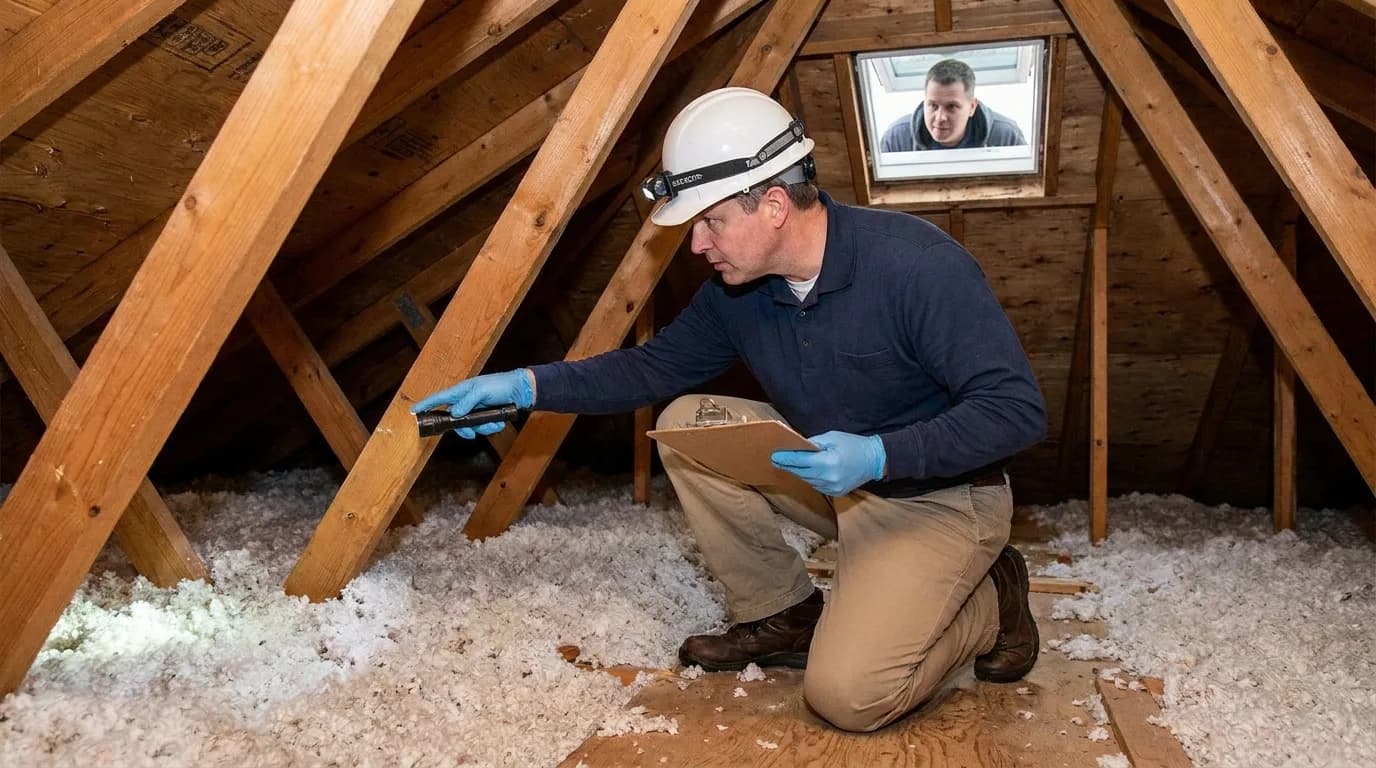
Ice dams need three things: snow on the roof, heat reaching the deck to melt it, and a cold edge to refreeze it. You cannot change the snow or the cold edge. You can change the heat. That means sealing the paths warm air takes into the attic (pot lights, attic hatches, plumbing stacks, top plates, bathroom fan housings), then adding insulation so the roof deck stays close to outdoor temperature, then ventilating so any heat that does get through is carried away.
Alberta building practice commonly cites a ventilation ratio of about 1:300 net free vent area to attic floor, balanced between soffit intake and ridge or roof vent exhaust. Many older Airdrie attics fall short, and many newer ones have baffles that have slipped or insulation stuffed into the soffits. Our guide to attic ventilation and roof vents in Alberta explains how to check yours.
The roofing side matters too. Ice-and-water shield at the eaves, standard practice under the Alberta Building Code for new roofs, is the membrane that stops a dam from becoming a leak even when one forms. If your roof is old enough not to have it, that is one of the signs you need a new roof that homeowners rarely think about, and a reroof is the moment to fix the eaves detailing, the ventilation and the cable question all at once.
Get the ice dam problem diagnosed before you buy cable
Roof heat cable is a good product for the right roof. It is a poor substitute for finding out why your roof is melting snow in January. Before you spend on cable, it is worth having someone look at the attic, the vents, the eaves detailing and the eavestroughs together, because the answer is often cheaper and more permanent than a heating system on the roof.
Apex Roofing Airdrie offers a free on-site inspection that covers exactly that, with an itemised written quote for whatever makes sense and no obligation. A fall visit through our roof maintenance service in Airdrie also gets the eavestroughs cleared and the existing cable checked before the first freeze, which is when it needs to be working.
Written by the Apex Roofing Airdrie crew
Practical guidance from the local roofers who inspect, repair and replace roofs across Airdrie and Rocky View County every season. We review our guides against current Alberta practice and update them when materials, code or insurer behaviour changes. About our team.