In this guide
- 01Roof cost per square foot in Canada: the 2026 ranges by material
- 02What a roofing square is, and why roofers do not quote per square foot
- 03How to measure a roof from the ground: footprint times pitch factor
- 04Waste factors: hips, valleys, dormers and the roof square footage calculator problem
- 05Worked examples: 1,200, 1,800 and 2,400 sq ft footprints
- 06Why the roof cost per square foot moves within the range
- 07Metal roof cost per square foot: where the extra money goes
- 08Repairs and partial reroofs: when per square foot stops making sense
- 09Turning your estimate into a real number
Roof cost per square foot in Canada: the 2026 ranges by material
Roof cost per square foot is the fastest way to sanity-check a quote, and the number most homeowners search for first. The table below gives installed ranges for Alberta as of 2026, including tear-off of one layer, disposal, synthetic underlayment, ice-and-water shield at the eaves and valleys, new flashings and standard ventilation. These are rough market guides, not quotes; your roof's pitch, height, complexity and decking condition move the number within the range.
| Roof material | Rough 2026 installed cost per sq ft (guide) | Per square (100 sq ft) | Typical Alberta lifespan |
|---|---|---|---|
| 3-tab asphalt | $4.00–$6.50 | $400–$650 | 12–18 years; rarely worth it in Hailstorm Alley |
| Architectural asphalt | $5.00–$9.00 | $500–$900 | 18–25 years |
| Class 4 impact-resistant asphalt | $6.50–$11.00 | $650–$1,100 | 20–30 years; insurer discounts common |
| Exposed-fastener metal panel | $10.00–$16.00 | $1,000–$1,600 | 30–45 years |
| Standing seam metal | $12.00–$22.00 | $1,200–$2,200 | 40–60 years |
| Rubber / EPDM / TPO (flat) | $13.00–$20.00 | $1,300–$2,000 | 20–30 years |
| Cedar shake | $14.00–$22.00 | $1,400–$2,200 | 20–30 years with maintenance |
Two notes on reading it. First, roof shingles cost per square foot climbs sharply at the Class 4 line, but insurer premium discounts on impact-resistant shingles often recover part of the difference over the life of the roof; our guide to Class 4 impact-resistant shingles in Alberta has the details. Second, metal roof cost per square foot looks like double asphalt, and it is, but the lifespan is also roughly double, which is why the metal roof cost guide for Alberta works the comparison over 50 years rather than at install.
What a roofing square is, and why roofers do not quote per square foot
A roofing square is 100 square feet of roof surface. It is the unit every roofer, supplier and insurance adjuster uses, so a quote will say "22 squares" rather than "2,200 square feet". Cost per square roofing figures are simply the per-square-foot numbers above multiplied by 100: $500 to $900 per square for architectural asphalt, $1,200 to $2,200 for standing seam.
Shingles are sold in bundles, and for architectural products it takes three bundles to cover one square (some heavier designer lines take four or five). A 22-square roof therefore needs 66 bundles before waste. Starter strip, ridge cap, underlayment and ice-and-water are sold per roll and priced separately, which is why the material line on an itemised quote is more than shingles alone. Our guide to shingle prices in Canada for 2026 lists bundle costs by brand and grade.
The per-square convention also explains why the smallest roofs have the highest cost per square foot. Setup, bin, disposal, tear-off crew time and flashing work do not scale down with area, so a 12-square bungalow in Big Springs often costs more per square than a 28-square two-storey in Cooper's Crossing.
How to measure a roof from the ground: footprint times pitch factor
You do not need to climb up. The roof area of a simple gable or hip roof is the building footprint (including overhangs) multiplied by a pitch factor. The footprint is the length times the width of the house measured at the eaves; add roughly 0.5 m (18 inches) on each side for overhangs if you are measuring the walls. The pitch factor accounts for the slope: a steeper roof has more surface over the same footprint.
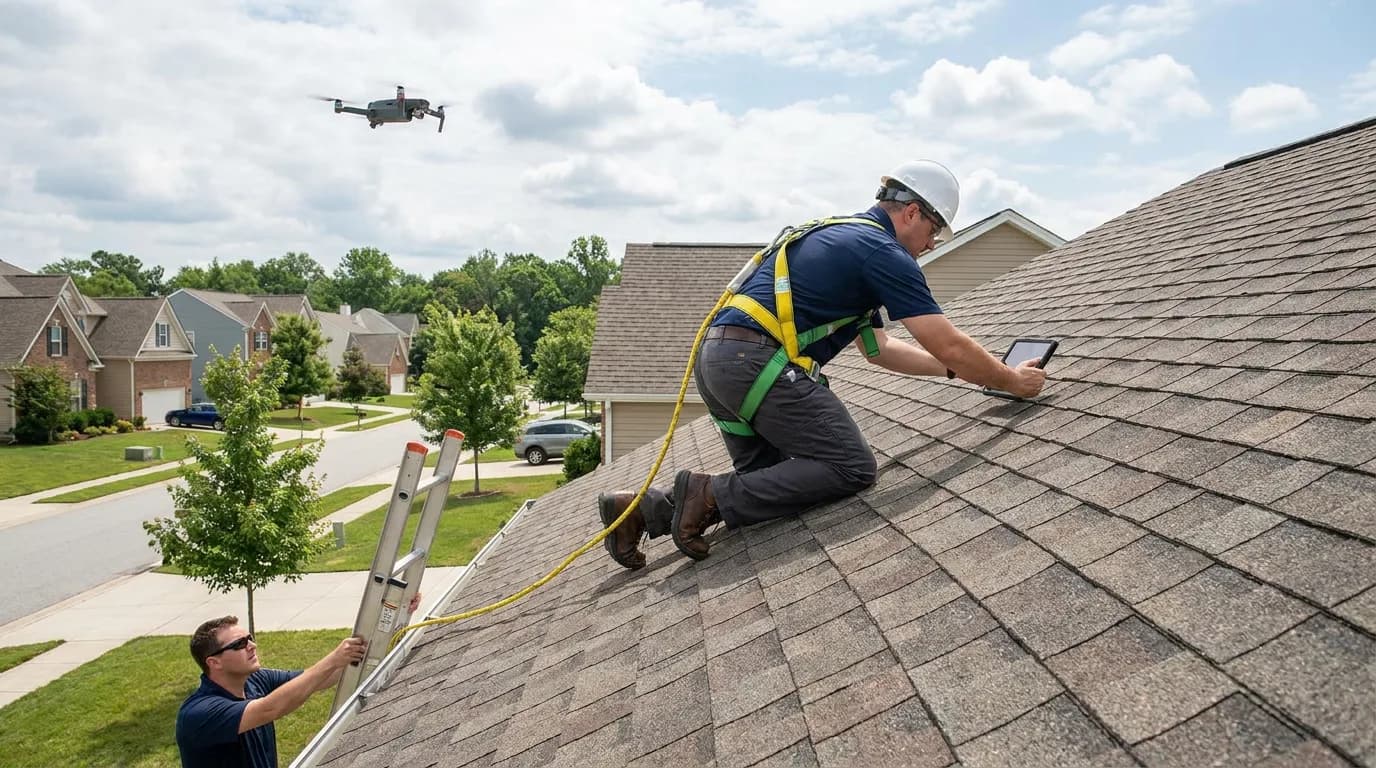
Roof pitch is expressed as rise over 12 inches of run. A 4/12 roof rises 4 inches for every 12 inches horizontal; a 12/12 roof is a 45 degree slope. You can read pitch with a level and tape in the attic (measure rise over 12 inches along a rafter) or from a ladder at the eave, and our guide to roof pitch explained, with a calculator walks through it. Most Airdrie homes built since the 1990s fall between 4/12 and 8/12; the newer estate lots in Cooper's Crossing and Bayside often have 8/12 to 12/12 sections.
| Roof pitch | Angle (approx.) | Pitch multiplier | 1,800 sq ft footprint becomes |
|---|---|---|---|
| 3/12 | 14° | 1.03 | 1,854 sq ft |
| 4/12 | 18° | 1.05 | 1,890 sq ft |
| 5/12 | 23° | 1.08 | 1,944 sq ft |
| 6/12 | 27° | 1.12 | 2,016 sq ft |
| 7/12 | 30° | 1.16 | 2,088 sq ft |
| 8/12 | 34° | 1.20 | 2,160 sq ft |
| 9/12 | 37° | 1.25 | 2,250 sq ft |
| 10/12 | 40° | 1.30 | 2,340 sq ft |
| 11/12 | 42.5° | 1.36 | 2,448 sq ft |
| 12/12 | 45° | 1.41 | 2,538 sq ft |
For a house with two or three roof sections at different pitches, measure each footprint separately, apply its own multiplier and add them up. Attached garages count; their roofs need shingles too.
Waste factors: hips, valleys, dormers and the roof square footage calculator problem
Every roof square footage calculator online gives you the geometric area and stops there. Roofers add waste, because shingles are cut at every hip, valley, edge and penetration, and offcuts cannot always be reused. The waste factor depends on complexity.
- Simple gable roof with no valleys: add 5 to 10 percent.
- Hip roof (four sloping sides): add 10 to 15 percent, because every hip is a diagonal cut line.
- Multiple valleys, dormers or intersecting rooflines: add 15 to 20 percent.
- Steep roofs above 8/12 add labour rather than material, but crews often carry an extra bundle or two for safety anchoring and edge work.
A rough way to think about it: a plain rectangular bungalow is a 10 percent roof, a typical Airdrie two-storey with a front gable, a hip over the garage and a valley or two is a 15 percent roof, and a custom home with dormers and a turret is a 20 percent roof. Add the waste to the pitch-adjusted area, then divide by 100 to get squares.
Worked examples: 1,200, 1,800 and 2,400 sq ft footprints
Here is the arithmetic applied to three common Airdrie house sizes, using the mid-range pitch and waste for each and the 2026 architectural asphalt and standing seam metal ranges from the first table. Roof cost per square foot is applied to the finished square count, not the footprint, which is the step most online estimates skip.
| Footprint | Typical home | Pitch and multiplier | Waste | Roof area and squares | Architectural asphalt ($5–$9/sq ft) | Standing seam metal ($12–$22/sq ft) |
|---|---|---|---|---|---|---|
| 1,200 sq ft | Bungalow, simple gable, attached garage included | 5/12 × 1.08 | 10% | ≈1,425 sq ft ≈ 14 squares | $7,100–$12,800 | $17,100–$31,400 |
| 1,800 sq ft | Two-storey with garage, one or two valleys | 6/12 × 1.12 | 15% | ≈2,320 sq ft ≈ 23 squares | $11,600–$20,900 | $27,800–$51,000 |
| 2,400 sq ft | Large two-storey or bungalow with walk-out, hips and dormers | 8/12 × 1.20 | 15% | ≈3,310 sq ft ≈ 33 squares | $16,600–$29,800 | $39,700–$72,800 |
Those ranges line up with what Airdrie homeowners actually pay: roughly $6,000 to $10,000 for a bungalow, $10,000 to $16,000 for a typical two-storey and $16,000 and up for large or steep homes in asphalt, as our pillar guide to roof replacement cost in Airdrie sets out in more detail. Where a specific house lands inside its range depends on the factors in the next section.
If you would rather not do the multiplication, our roof cost calculator takes footprint, pitch, complexity and material and returns a range in a few seconds. It is a planning tool, not a quote.
Why the roof cost per square foot moves within the range
Two roofers can measure the same house, get the same 23 squares, and still be $4,000 apart. The roof cost per square foot is where the difference hides, and these are the things that move it.
- Tear-off layers: removing two layers of old shingles adds labour and disposal; a layover skips both but is a short-term saving.
- Decking replacement: priced per sheet, usually $80 to $150 installed as a 2026 guide, and only known after tear-off.
- Ice-and-water shield coverage: eaves only versus eaves, valleys, penetrations and low-slope sections; full coverage on a 3/12 roof adds material.
- Flashing: new step, counter and chimney flashing versus reusing what is there.
- Ventilation upgrades: adding ridge vent or intake to meet the commonly cited 1:300 ratio.
- Height and pitch: two-storey and steeper than 8/12 roofs need more fall protection and slower work.
- Access: tight lots in older neighbourhoods like Meadowbrook or homes backing onto green space with no rear access add carrying time.
- Season and demand: after a major hail event, such as the August 8, 2026 storm through the Crossfield to Airdrie corridor, crews are booked and rates firm up.
When you compare quotes, compare the scope line by line before the price. A quote that is $1.50 per square foot cheaper because it reuses flashing and skips valley ice-and-water is not the same product.
Metal roof cost per square foot: where the extra money goes
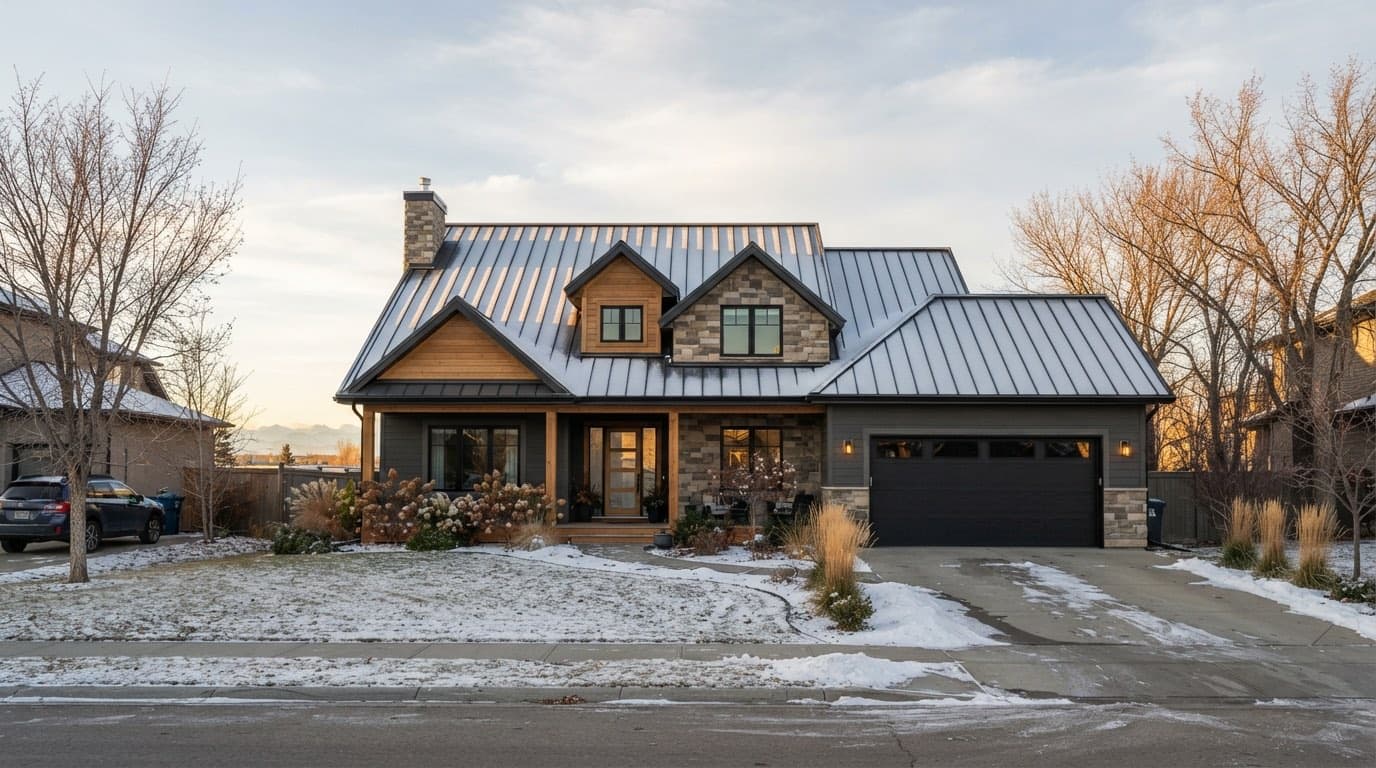
Standing seam metal at $12 to $22 per square foot is the range that surprises people most. The panel itself is only part of it. Standing seam is cut to length on site or in the shop, every panel is hand-seamed or machine-seamed, and the flashing details at valleys, walls, chimneys and penetrations are custom metalwork rather than off-the-shelf pieces. A metal roof also usually goes over a full high-temperature underlayment, and hips and ridges use formed caps.
Exposed-fastener metal panels, the kind common on shops and rural buildings, are cheaper at $10 to $16 per square foot because the panels are stock lengths screwed through the face, but the thousands of screws and washers are the maintenance point. Snow management is a real cost on either type in Alberta; our guide to snow guards for metal roofs explains why they are usually needed over doors and walkways. For a full breakdown of what our metal roofing service in Airdrie includes, that page walks through the options.
Repairs and partial reroofs: when per square foot stops making sense
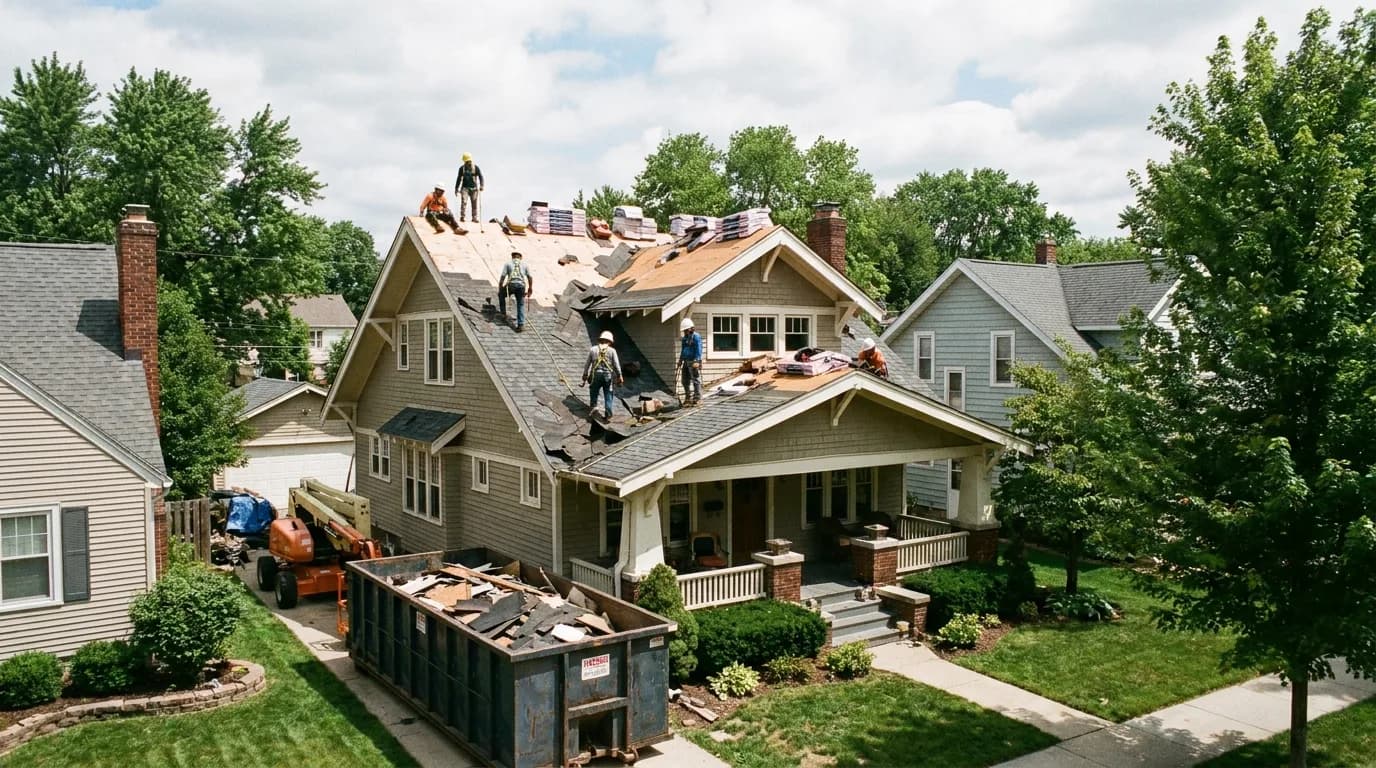
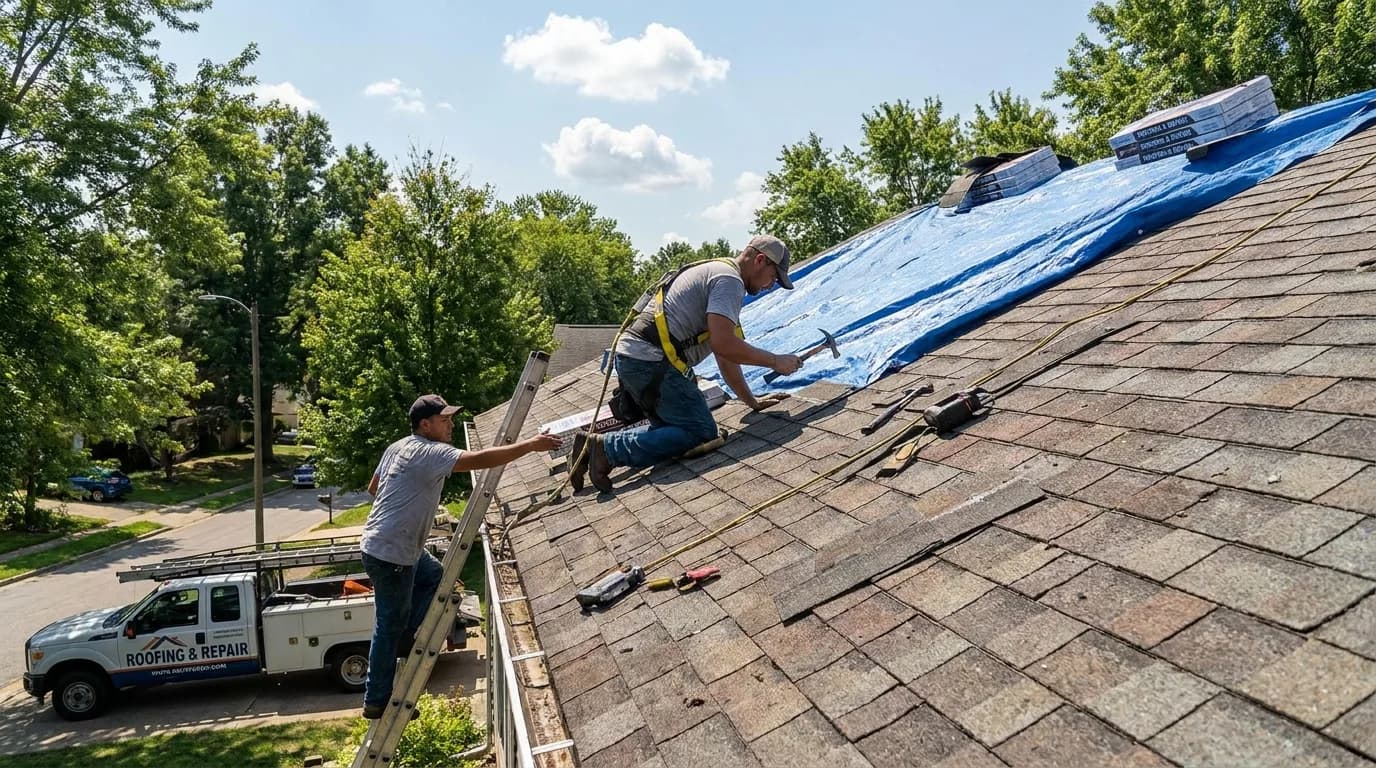
Roof cost per square foot only works as a measure for full slopes. A repair of a few lifted shingles after a Chinook wind, or a single hail-bruised slope, is priced on time, access and materials, which is why small repairs run roughly $300 to $1,500 as a 2026 guide even though the area involved is tiny. Setup and the trip cost the same whether the crew replaces two shingles or twenty.
Partial reroofs, replacing one or two slopes, sit in between. The per-square rate is higher than a full reroof because the crew still needs the bin, the setup and the tie-in flashing where new meets old, and colour-matching a five-year-old shingle is rarely perfect. If more than about a third of the roof needs work, pricing the whole thing usually makes more sense; our guide to roof repair versus replacement helps you decide.
Turning your estimate into a real number
Measure the footprint, look up the pitch factor, add the waste, and you will have a square count within 10 percent of what a roofer measures. Apply the roof cost per square foot range for the material you want and you have a budget that will not embarrass you when the quotes arrive.
The step after that is a free, no-obligation on-site estimate from Apex Roofing Airdrie. We measure the roof properly, check the decking and ventilation from the attic, and give you an itemised written quote that shows the squares, the product, the per-sheet decking rate and everything else, so you can see exactly how the per-square-foot figure was built. Our roof replacement service in Airdrie page explains what every quote includes, and same-week estimate booking is available.
Written by the Apex Roofing Airdrie crew
Practical guidance from the local roofers who inspect, repair and replace roofs across Airdrie and Rocky View County every season. We review our guides against current Alberta practice and update them when materials, code or insurer behaviour changes. About our team.