In this guide
- 01Roof Pitch Explained: What the Numbers Actually Mean
- 02How to Measure Roof Pitch Without Climbing on the Roof
- 03Roof Pitch Chart: Common Pitches, Degrees and Names
- 04Roof Pitch Multiplier Table: Estimating Your Roof Area
- 05Why Steep Roofs Cost More to Replace
- 06Low Slope vs Steep Roof in Alberta: Snow, Ice and Chinooks
- 07Minimum Roof Pitch for Shingles, Metal and Membranes
- 08What a Roof Pitch Calculator Actually Does
- 09Typical Roof Pitches on Airdrie Homes
- 10Get an Exact Roof Measurement With a Free Estimate
Roof Pitch Explained: What the Numbers Actually Mean
Roof pitch is one of those terms that gets thrown around in every roofing quote, yet most homeowners have never had it explained. It is simply a way of describing how steep your roof is. In Canada and the US it is written as a ratio: the number of inches the roof rises vertically for every 12 inches it runs horizontally. A 4/12 roof rises 4 inches per foot, a 6/12 roof rises 6 inches per foot, and a 12/12 roof rises 12 inches per foot, which puts it at exactly 45 degrees.
You will also hear the words slope and pitch used as if they mean the same thing, and for a homeowner they effectively do. Strictly speaking, slope is rise over run (6/12), while pitch in old carpentry language was rise over the full span of the building (a 6/12 slope on a 24-foot span was called a 1/4 pitch). Almost nobody uses the old definition any more, so when a roofer says pitch, they mean the rise-over-12 figure.
Degrees are the third way of describing steepness, and they are what a phone app or a builder's level will show you. A 4/12 roof is about 18 degrees, 6/12 is about 27 degrees, 8/12 is about 34 degrees and 12/12 is 45 degrees. The chart further down converts between all three so you can read any quote or product spec without guessing.
Why does any of this matter to you? Because pitch drives three things you care about: how much roof surface you actually have (and therefore how much material you pay for), how hard and slow the roof is to work on, and what roofing products are allowed to go on it. Get those three right and the rest of a roof replacement quote in Airdrie makes a lot more sense.
How to Measure Roof Pitch Without Climbing on the Roof
There are three reliable ways to measure roof pitch, and none of them require you to walk on shingles. Measuring from the attic is the most accurate because you are reading the underside of the roof deck directly, with no eavestrough or fascia in the way.
- From the attic with a level and tape: hold a 12-inch level (or mark 12 inches on a longer one) horizontally against the underside of a rafter, with one end touching the rafter. Level the bubble, then measure straight down from the free end of the level to the rafter. That vertical measurement in inches is your pitch. If it reads 6 inches, you have a 6/12 roof.
- On the roof edge or a ladder: stand a ladder safely at the eave and lay the level on the shingle surface, running up the slope. Same method: level it, measure the drop at the 12-inch mark. Only do this if you can stand on the ladder comfortably with both hands free.
- With a phone app from the ground: most phones have a built-in level or measure app that reports angle in degrees. Line the edge of the phone up with the roof slope as seen from the side of the house, read the angle, then convert with the chart below. Expect a degree or two of error.
- From the gable end with a tape and a friend: measure the total rise from the top plate of the wall to the ridge and the horizontal run from the outside wall to the centre of the ridge. Divide rise by run and multiply by 12.
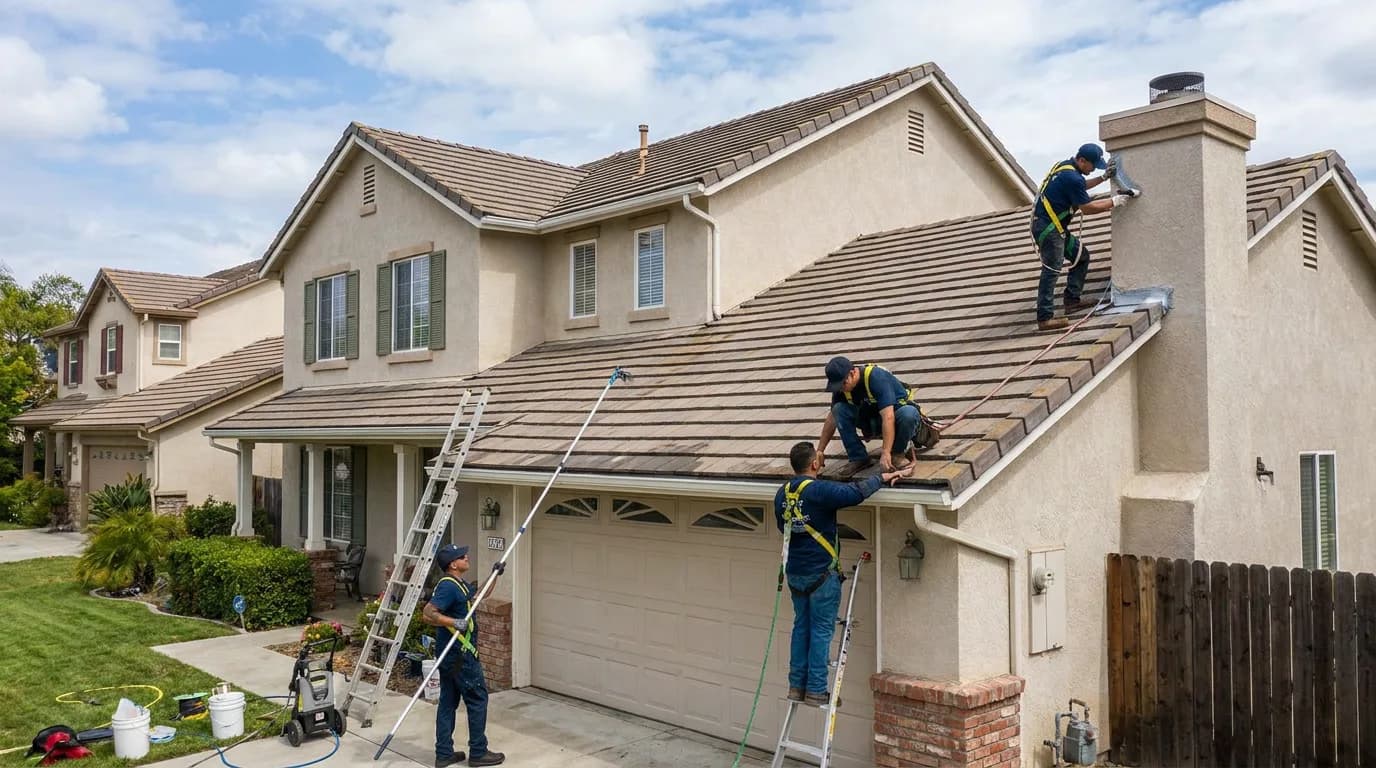
Whichever method you use, take two readings on different slopes. Most Airdrie homes have one main pitch, but many two-storey homes in Cooper's Crossing, Kings Heights and Bayside mix a 6/12 main roof with a steeper 8/12 or 10/12 gable feature over the entry, and bungalows in Big Springs and Thorburn often have a lower 4/12 garage roof attached to a 5/12 or 6/12 house.
If your attic is finished or you cannot get a safe reading, do not worry about it. Any roofer doing a free estimate will measure pitch as part of the visit, and satellite measurement tools can read it to within half an inch from imagery.
Roof Pitch Chart: Common Pitches, Degrees and Names
The roof pitch chart below covers the range you will see on residential homes in Alberta. Anything under about 3/12 is treated as low slope and usually needs a membrane instead of shingles. Anything from 4/12 to 8/12 is considered conventional and walkable with care. Anything 9/12 and above is steep, and 12/12 or more is what roofers call non-walkable.
| Pitch (rise/12) | Angle (degrees) | Common name | Walkable? |
|---|---|---|---|
| 1/12 | 4.8 | Flat / low slope | Yes, membrane only |
| 2/12 | 9.5 | Low slope | Yes, membrane or special shingle install |
| 3/12 | 14.0 | Low slope | Yes |
| 4/12 | 18.4 | Conventional (low end) | Yes |
| 5/12 | 22.6 | Conventional | Yes |
| 6/12 | 26.6 | Conventional (Alberta average) | Yes, with care |
| 7/12 | 30.3 | Moderate | With roof jacks |
| 8/12 | 33.7 | Moderate to steep | With roof jacks and harness |
| 9/12 | 36.9 | Steep | Harness required |
| 10/12 | 39.8 | Steep | Harness and staging |
| 12/12 | 45.0 | Very steep | Non-walkable |
| 14/12 and up | 49.4+ | Extremely steep | Non-walkable, scaffold |
The walkable column is about crew safety and speed, and it is the single biggest reason a steep roof costs more per square than a low one. We will come back to that in the cost section.
Roof Pitch Multiplier Table: Estimating Your Roof Area
A roof always has more surface area than the footprint of the house underneath it, because it slopes. The steeper the slope, the bigger the difference. The roof pitch multiplier is the number you multiply the flat footprint by to get the true sloped area. It comes straight from geometry: the multiplier is the square root of (rise squared plus 144) divided by 12.
| Pitch | Roof pitch multiplier | Extra area vs footprint |
|---|---|---|
| 2/12 | 1.014 | 1.4% |
| 3/12 | 1.031 | 3.1% |
| 4/12 | 1.054 | 5.4% |
| 5/12 | 1.083 | 8.3% |
| 6/12 | 1.118 | 11.8% |
| 7/12 | 1.158 | 15.8% |
| 8/12 | 1.202 | 20.2% |
| 9/12 | 1.250 | 25.0% |
| 10/12 | 1.302 | 30.2% |
| 12/12 | 1.414 | 41.4% |
To use it, measure the outside dimensions of your house including eave overhangs (usually add 1 to 2 feet on each side), multiply length by width to get the footprint, then multiply by the pitch multiplier. Divide by 100 to convert square feet into roofing squares, which is how shingles are sold and priced.
Worked example for a typical Airdrie bungalow: a 40 by 30 foot house with 1.5-foot overhangs is 43 by 33 feet, a footprint of about 1,420 square feet. At 6/12 the sloped area is 1,420 multiplied by 1.118, or about 1,590 square feet, which is 15.9 squares. Add 10 to 15 percent for waste, starter strip and ridge cap, and the roofer will order roughly 18 squares of shingles. At a 2026 market guide of about $450 to $800 per square installed for architectural asphalt, that lands somewhere in the $8,000 to $14,000 range before extras such as decking repairs or upgraded underlayment. That is a rough guide only; a free on-site quote gives you the exact figure.
The same house at 10/12 would have about 1,850 square feet of roof, or 18.5 squares before waste. That is 16 percent more shingles, and as the next section explains, each of those squares also costs more to install. This is why two houses with the same footprint on the same street in Ravenswood can get quotes several thousand dollars apart.
Why Steep Roofs Cost More to Replace
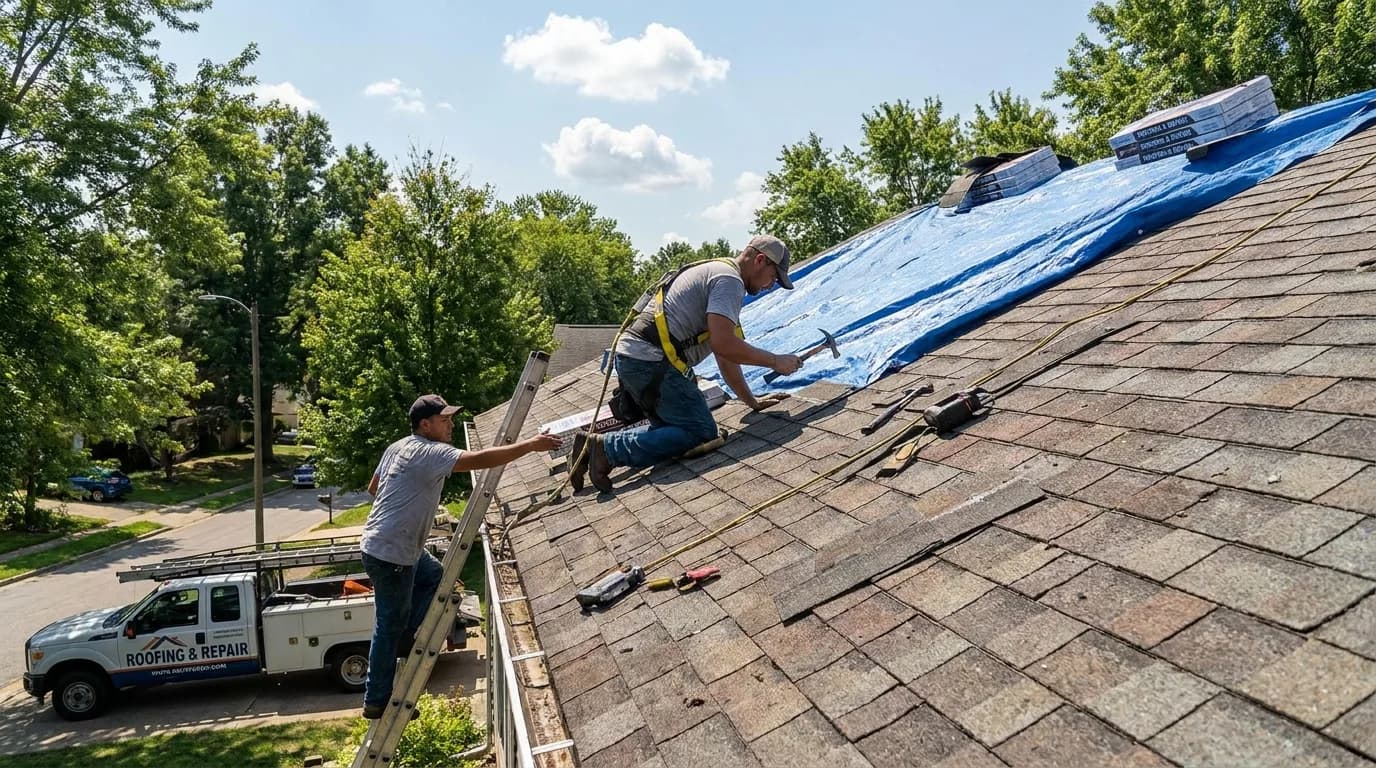
Steep roofs cost more for reasons that have nothing to do with the shingles themselves. Roughly 6/12 and above starts to add labour, because a crew can no longer simply walk the roof carrying bundles. At 7/12 and 8/12 they need roof jacks and planks to create footholds, and every worker is tied off to an anchor. At 9/12 and above the job slows down again: bundles have to be staged and secured so they do not slide, each course of shingles is nailed from a plank rather than from a standing position, and tear-off debris has to be controlled rather than swept.
Here is what that looks like in practice on a reroof:
- More set-up time: anchors, lifelines, roof jacks and sometimes scaffolding at the eaves all have to be installed before the first shingle comes off, then removed and the anchor holes sealed at the end.
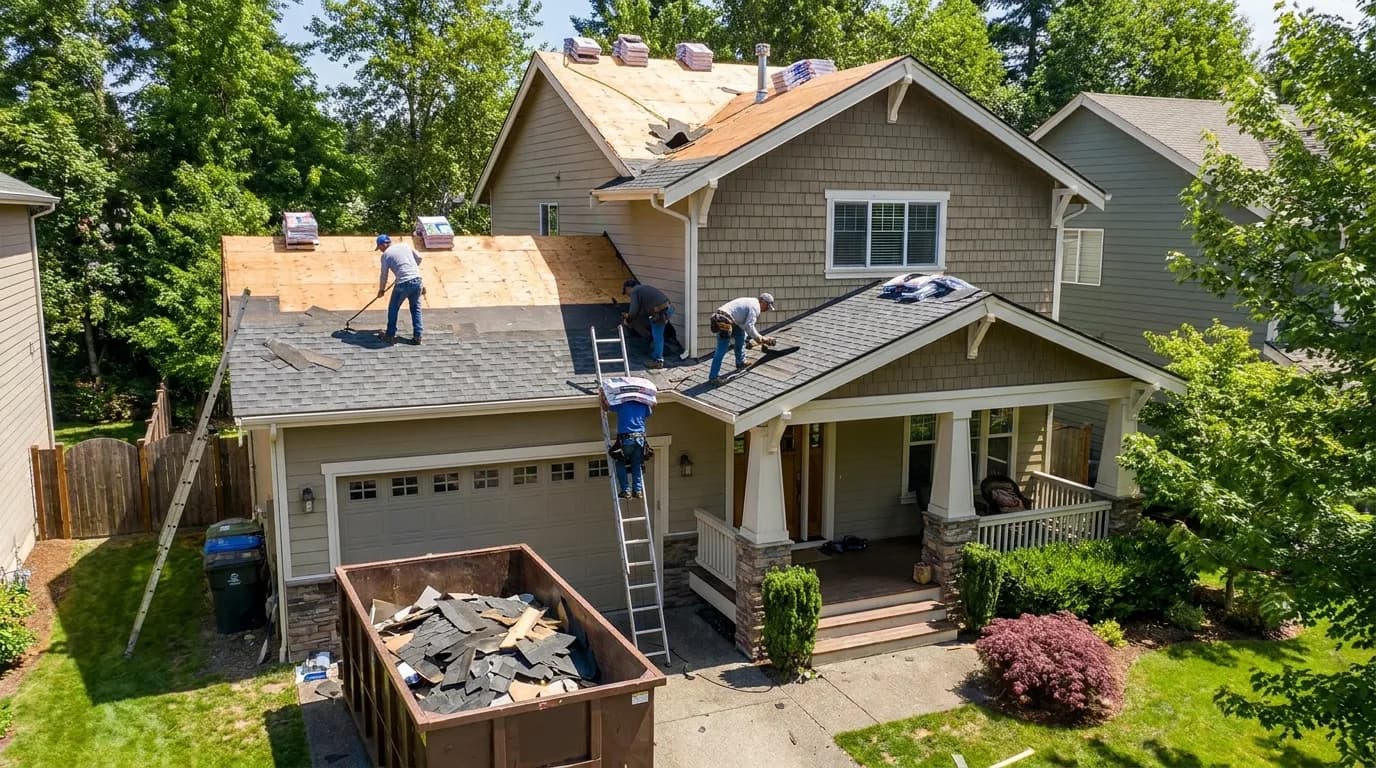
- Slower tear-off and install: a crew that strips and reshingles 20 squares a day on a 5/12 might do 12 to 14 on a 10/12. Labour is charged by the day, so the per-square rate rises.
- More waste and more cuts: steep roofs tend to come with dormers, hips and valleys, and every one of those features means more cut shingles, more flashing and more ice-and-water membrane.
- Higher material quantity: the multiplier above means more squares of everything, including underlayment, starter strip, ridge cap and nails.
- Equipment costs: very steep or tall roofs sometimes need a lift or boom to get bundles up safely, which is a rental cost passed through on the quote.
As a rough 2026 guide, expect the installed price per square on an 8/12 to 9/12 roof to run about 10 to 20 percent above the same shingle on a 5/12, and a 12/12 roof with dormers to run 25 to 40 percent above. Our guide to how long a roof replacement takes explains why the steep jobs also stretch from one day into two or three.
If you are comparing quotes and one contractor has not asked about or measured pitch, be cautious. A price per square that ignores pitch either hides a big change order later or means corners will be cut on fall protection. Alberta occupational health and safety rules require fall protection on residential roofs, and a legitimate crew builds that time into the price.
Low Slope vs Steep Roof in Alberta: Snow, Ice and Chinooks
Pitch does not only affect price. It changes how your roof behaves through an Alberta winter, and the differences are worth understanding before you choose a roofing material or decide how much to invest in ventilation and ice protection.
Low slope roofs (under about 4/12) hold snow. That is not automatically a problem, because snow is an insulator and a well-built roof carries the load without complaint. The issue is meltwater. On a low slope, water moves slowly toward the eaves, so any heat leaking from the house into the attic has more time to melt the snow from below, and the meltwater has more time to refreeze at the cold eave. That is the recipe for ice dams. Low-slope roofs in Airdrie need excellent attic insulation, ventilation and a generous run of ice-and-water shield to stay dry.
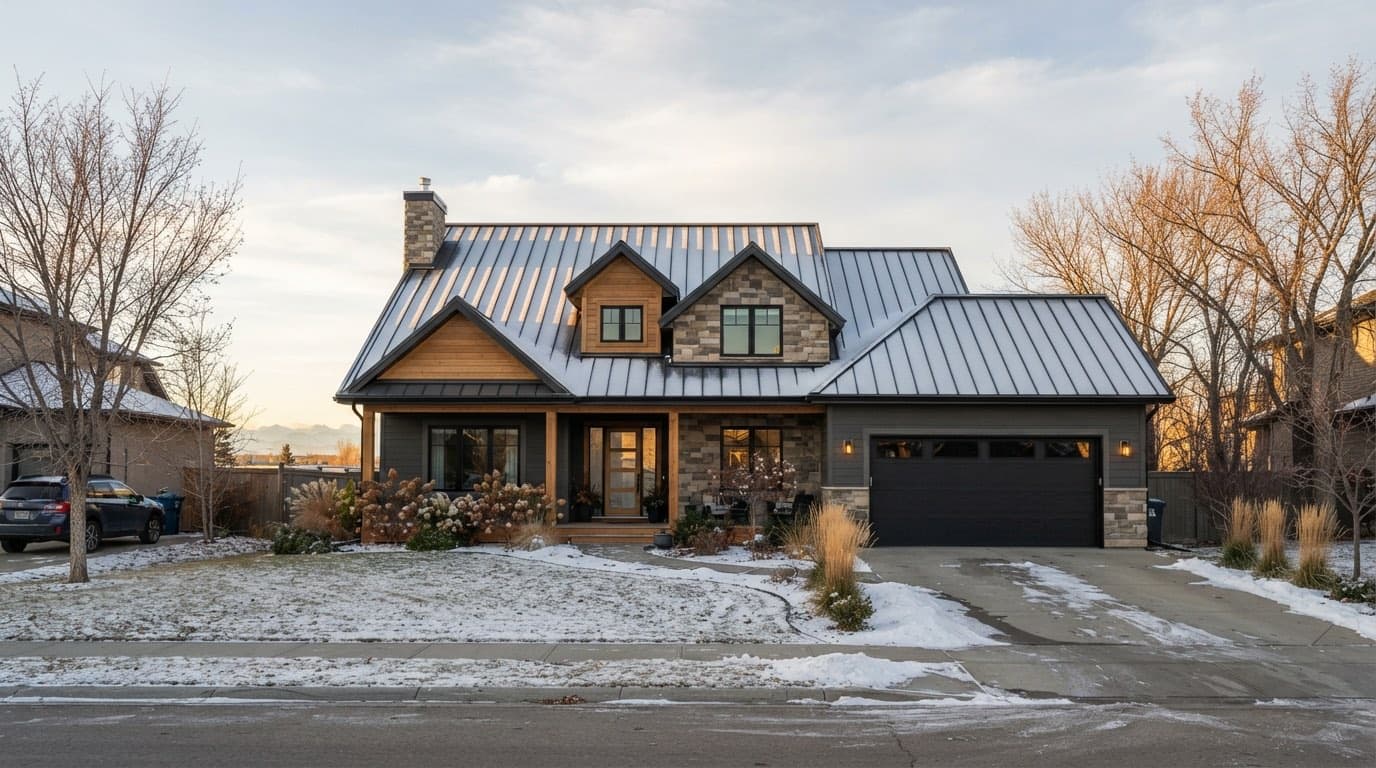
Steep roofs (9/12 and up) shed snow readily, especially during a Chinook when the surface warms quickly. That protects them from ice damming and heavy loads, but it creates a different hazard: sliding snow. Metal roofs on steep pitches can release an entire slope of snow at once onto a deck, a walkway or an eavestrough, which is why snow guards are standard on steep metal in Alberta. Steep asphalt roofs shed more gradually because the granular surface adds friction.
Conventional pitches from 5/12 to 8/12 sit in the sweet spot for the prairie climate. They drain well enough to limit ice dams, hold enough snow that sliding is rarely dangerous, and they are still walkable for inspections and maintenance. It is no accident that most Airdrie subdivisions built in the last 30 years use roofs in this range. Our post on how to prevent ice dams in Airdrie covers the ventilation and insulation side in detail.
Wind matters too. Prairie gusts and Chinooks exert more uplift on a low roof than a steep one at the eaves and ridge, while a steep roof presents more surface to a strong crosswind. Either way, the answer is the same: proper nailing pattern, sealed starter strip and a shingle with a high wind rating, rather than a different pitch.
Minimum Roof Pitch for Shingles, Metal and Membranes
Every roofing product has a minimum pitch below which the manufacturer will not warranty it, because water does not drain fast enough to stay out of the laps. The numbers below are typical manufacturer requirements for the brands commonly sold in Alberta. Always confirm with the specific product's installation instructions, since they are what a warranty claim will be judged against.
| Roofing material | Minimum pitch | Notes |
|---|---|---|
| Asphalt shingles (standard install) | 4/12 | Standard underlayment and nailing |
| Asphalt shingles (low-slope install) | 2/12 | Full ice-and-water membrane or double underlayment required; some warranties reduced |
| Metal shingles / interlocking panels | 3/12 (some 4/12) | Product-specific; check the profile |
| Standing seam metal (mechanically seamed) | 1/2 /12 to 1/12 | Sealed seams allow near-flat use |
| Standing seam metal (snap-lock) | 3/12 | Lower pitches need sealant in the seams |
| Rubber or synthetic shingles | 3/12 to 4/12 | Varies by brand; Euroshield lists product-specific minimums |
| Cedar shakes and shingles | 4/12 (shingles 3/12 with reduced exposure) | Needs good drainage and airflow |
| SBS modified bitumen / torch-on | Flat to 2/12 | Standard for low-slope garages and additions |
| TPO / EPDM membrane | Flat to 2/12 | Commercial and some residential flat roofs |
In Airdrie, the most common place this matters is a low-slope addition, a covered deck or an attached garage roof sitting at 2/12 or 3/12 beside a shingled house. Homeowners often assume the roofer will just continue the shingles across it. On anything under 4/12 that means a low-slope install with full membrane coverage, and under 2/12 it means a different product altogether. A quote that shingles a 1.5/12 porch roof is a leak waiting to happen. If you have a flat or nearly flat section, our flat roof repair cost and materials guide walks through the options.
Metal deserves a mention because it is the product people most often ask about when their roof is either very low or very steep. Mechanically seamed standing seam can go almost flat, and metal on a steep pitch sheds snow and hail well. Our metal roofing service page covers the profiles we install and where each fits.
What a Roof Pitch Calculator Actually Does
Search for roof pitch calculator and you will find dozens of free tools. They all do one of two jobs, and it helps to know which you are using.
The first kind converts between units. You enter a rise and a run, or an angle, and it returns the pitch ratio, the angle in degrees, the percentage grade and the multiplier. That is useful when you have an angle from a phone app and want the rise-over-12 figure, or the other way round. The math is the tables in this article.
The second kind estimates roof area and material. You enter the footprint dimensions and the pitch, and it applies the multiplier, adds a waste allowance and tells you how many squares or bundles you need. Some go further and multiply by an average cost per square to produce a budget figure. These are fine for a rough sense of scale before you call anyone.
What a calculator cannot do is see your roof. It does not know that the back slope is 8/12 while the front is 6/12, that there are three dormers and a chimney, that the garage roof is low slope, or that the decking under the north valley has rotted. It also does not know local pricing, which in Alberta swings with shingle prices, hail season demand and the time of year. Use a calculator to sanity-check a quote, not to replace one. Our current shingle prices in Canada for 2026 post gives realistic per-bundle and per-square numbers to plug in if you want a closer estimate.
A quick sanity check for any calculator output: for a typical two-storey Airdrie home with a 6/12 to 8/12 roof, the total roof area usually lands between 18 and 30 squares. If a tool tells you 9 squares or 50, recheck your footprint, because you have probably measured the main floor only or included the driveway.
Typical Roof Pitches on Airdrie Homes
Pitch varies by the era and style of the house, and Airdrie has a wide mix. Knowing what is typical for your neighbourhood helps you spot whether a quote is in the right ballpark.
- 1970s and 1980s bungalows and bi-levels (Big Springs, Thorburn, Meadowbrook, parts of Jensen): mostly 4/12 to 5/12, simple gable or hip roofs, easy to walk and quick to reroof.
- 1990s and early 2000s two-storeys (Summerhill, Woodside, Fairways, Silver Creek): 6/12 main roofs, sometimes with a 8/12 front gable feature.
- 2005 to 2015 estate and move-up homes (Cooper's Crossing, Kings Heights, Bayside, Canals): 8/12 to 10/12 main roofs with multiple gables, dormers and long valleys. These are the roofs where pitch adds the most to the price.
- Newer builds since 2015 (Southwinds, Chinook Winds, Midtown, Windsong, Hillcrest, Reunion): a return to simpler 6/12 to 8/12 forms, often with a low-slope front porch or a flat-roofed modern section.
- Acreages and rural Rocky View properties around Balzac and Crossfield: anything from a 4/12 ranch roof to a 12/12 steep-pitch farmhouse, often with metal.
Steep-pitch estate roofs in the 2005 to 2015 bracket are also the ones most often hit hard by hail, because a 10/12 slope facing a storm presents its surface almost square-on to wind-driven stones. If your home is in that group and was built before Class 4 shingles became common, a hail inspection after each big storm is worth the free visit.
Get an Exact Roof Measurement With a Free Estimate
Measuring your own roof pitch and running the numbers through a calculator is a good way to walk into a quote informed. It will get you within about 15 percent of the real area on a simple roof, and it tells you immediately whether a contractor's per-square price is reasonable for your pitch.
For the exact figure, Apex Roofing Airdrie provides free, no-obligation on-site estimates with itemised written quotes. We measure every slope, note the pitch of each section, count the features that add cuts and flashing, and show you the square count and the price per square in writing, so you can compare it line by line with any other quote. Our crew is local and in-house, and every reroof comes with a written workmanship guarantee on top of the manufacturer warranty.
Book a same-week estimate through our roof replacement in Airdrie page, or if you only need a section fixed, start with roof repair in Airdrie. Either way, you will leave the conversation knowing exactly what your pitch means for your roof and your budget. For the broader picture on what a full reroof costs across the province, see our guide to roof replacement cost in Alberta.
Written by the Apex Roofing Airdrie crew
Practical guidance from the local roofers who inspect, repair and replace roofs across Airdrie and Rocky View County every season. We review our guides against current Alberta practice and update them when materials, code or insurer behaviour changes. About our team.