In this guide
- 01Attic Insulation Cost in Alberta: The Direct 2026 Answer
- 02Attic Insulation Cost Per Square Foot in Alberta, By Type
- 03Blown-In vs Batt vs Spray Foam vs Hybrid: Why the Price Differs
- 04Attic Top-Up Cost vs a Full Re-Insulation: When a Top-Up Is Enough
- 05R-Value Targets for Airdrie and Alberta's Climate
- 06What Changes Your Quote: Access, Removal, Air Sealing and the Vapour Barrier
- 072026 Alberta Price Examples by Attic Size
- 08Attic Insulation Rebates and Programs in Alberta
- 09DIY Top-Up vs Hiring a Pro: Where the Line Is
- 10Payback Period: How Much Attic Insulation Saves on Alberta Heating Bills
- 11Signs Your Attic Needs More Insulation
- 12Timing Attic Insulation With a Reroof: Insulation and Ventilation Together
Attic Insulation Cost in Alberta: The Direct 2026 Answer
Attic insulation cost in Alberta runs roughly $1.50 to $2.50 per square foot for a straightforward blown-in top-up as of 2026, and $3.50 to $8.50 per square foot where the job involves removing old material or spraying foam, as a rough Alberta market guide in CAD covering both materials and labour. For a typical 1,200 to 1,500 sq ft Airdrie attic, that puts a simple top-up somewhere between $1,800 and $3,750, and a full tear-out and re-insulation between roughly $4,200 and $9,000.
Where you land in that range depends on the insulation type, how much of the old material has to be removed, how many pot lights and bathroom fans need air sealing first, and how easy the attic hatch is to reach with a hose. The rest of this guide breaks each of those variables down with 2026 Alberta pricing, then covers R-value targets, rebates, DIY limits and when a top-up is not enough.
Attic insulation is not just a heating-bill line item in Alberta. A thin or gappy attic lets warm house air reach the underside of the roof deck, which melts the snowpack from below even during a hard Chinook freeze, and that meltwater refreezes at the cold eaves into ice dams that back water up under the shingles. Getting the attic insulation cost right the first time is cheaper than the roof damage an under-insulated attic causes over a few Alberta winters.
Most published insulation cost guides are written for Ontario or Quebec markets, where colder-climate targets and freeze-thaw cycling are less severe and material and labour rates differ. The figures in this guide are built as Alberta market ranges instead, because Airdrie's combination of hard Chinook swings, a long heating season and clay-based soils that already stress a home's building envelope makes attic performance a bigger factor here than in a milder or more moderate climate.
Attic Insulation Cost Per Square Foot in Alberta, By Type
Attic insulation cost per square foot in Alberta varies more by material than by anything else. Loose-fill products installed with a blower are the cheapest per square foot because the labour is fast; spray foam costs several times more because it requires a licensed applicator, specialized equipment and chemical components that are priced by the set, not the bag.
| Insulation type | R-value per inch (approx.) | Installed cost per sq ft, 2026 guide | Best for |
|---|---|---|---|
| Blown-in fibreglass | R-2.2 to R-2.7 | $1.50-$2.50 | Topping up an attic where existing insulation is dry and sound |
| Blown-in cellulose | R-3.2 to R-3.8 | $1.75-$2.75 | More R-value per inch where attic depth is limited |
| Batt fibreglass | R-3.0 to R-3.8 | $2.00-$3.50 | New construction or an attic with open, accessible joists |
| Open-cell spray foam | R-3.5 to R-3.6 | $3.50-$5.50 | Air sealing and insulating in one step, cathedral ceilings |
| Closed-cell spray foam | R-6.0 to R-7.0 | $5.50-$8.50 | Low-slope roofs and tight spaces that need maximum R per inch |
For most Airdrie bungalows and two-storeys with a standard truss attic and reasonable hatch access, blown-in fibreglass or cellulose covers the job at the lower end of the attic insulation cost range. Spray foam earns its price in cathedral ceilings, sloped sections and additions where loose fill cannot be contained, not in a normal flat attic.
These per-square-foot figures assume a reasonably accessible attic with a normal hatch, a simple roofline and no minimum-order surcharge. Insulation contractors often set a minimum job charge in the $400 to $700 range as a rough 2026 Alberta guide, regardless of square footage, so a very small attic, a garage ceiling or a single room addition can come in above the per-square-foot math on this table simply because the crew and equipment still have to show up and set up for the day.
Blown-In vs Batt vs Spray Foam vs Hybrid: Why the Price Differs
Blown-in insulation cost sits at the bottom of the range because a machine and a hose put material down fast, in one continuous layer that fills around wiring, plumbing stacks and irregular joist spacing without gaps. That is also why it is the default choice for a top-up: it settles on top of whatever is already there without disturbing it, and a crew can usually finish an average Airdrie attic in half a day.
Batt fibreglass costs more per square foot installed because it has to be cut and fitted by hand around every obstruction, and a crew working on their knees in a low attic moves slowly. It makes sense in new construction, where the joists are open and accessible before drywall goes up, and less sense as a retrofit over existing loose fill.
Spray foam costs the most because the truck-mounted rig, the two-component chemicals and the certified applicator are all priced into every job, regardless of size. What you get in return is an air seal and an insulation layer in a single pass, which matters most on cathedral ceilings, knee walls and additions where a continuous vapour and air barrier is hard to achieve any other way. A hybrid approach, foam or rigid baffles at the eaves to keep the soffit vents clear, then blown-in fill over the rest of the attic floor, is common in Alberta because it protects ventilation without paying spray-foam prices across the whole attic.
Product quality inside each category also moves the price a little. Borate-treated cellulose costs slightly more than plain fibreglass but resists pests and is naturally fire-retardant, which some Alberta insurers and inspectors favour. Blown-in fibreglass settles a small amount over the first year or two, so a contractor pricing to a firm R-value target usually blows in a bit more depth than the bare minimum to account for it; cellulose settles less but is denser and slightly heavier on older ceiling drywall, which matters in a handful of older Airdrie homes with lath-and-plaster rather than modern drywall.
Attic Top-Up Cost vs a Full Re-Insulation: When a Top-Up Is Enough
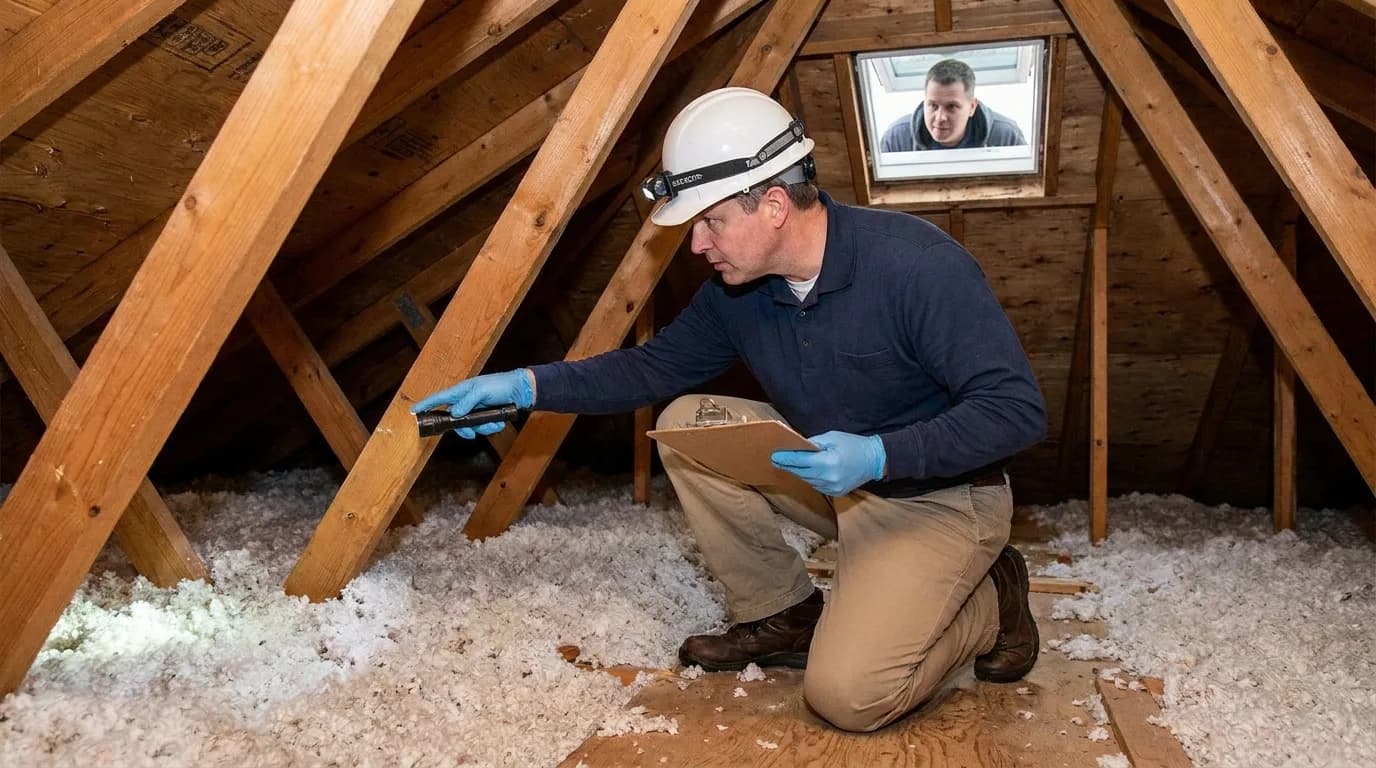
An attic top-up cost only makes sense when the insulation underneath is worth building on. Walk the attic, or have it inspected, and look for three things: is it dry, is it still fluffy rather than compacted flat, and is it free of rodent droppings, nesting material or visible mould. If all three check out, adding more of the same product on top is the cheapest and least disruptive path to a higher R-value.
A full tear-out and re-insulation is the right call when the existing material fails any of those checks. Insulation that has been wet, even once, loses much of its R-value permanently once it compacts and dries, and it usually means there was or still is a moisture source worth finding first; our guide to frost in the attic and what causes it covers the condensation problems that leave insulation soaked in a typical Alberta winter. Vermiculite insulation, common in homes built before the 1990s, may contain asbestos and should be assessed and removed by an abatement contractor rather than topped up or disturbed casually.
Removal adds a real line item to the attic insulation cost: expect roughly $0.75 to $1.50 per square foot as a rough 2026 Alberta guide, on top of the new material, to bag out and haul away old fibreglass or cellulose, more if it is wet or contaminated. That is still usually cheaper than living with an attic that is quietly failing.
Partial removal is a middle path worth asking about before committing to a full tear-out. If only a section of the attic has water staining, matting or contamination, for example near a bathroom fan vent or a chimney chase, a contractor can bag out just those bays and top up the rest of the attic at the standard rate, rather than removing and replacing insulation across the whole floor. Pricing usually follows the removal per-square-foot figure against the affected area only, plus the standard top-up rate everywhere else, so ask for the quote broken out that way rather than as one blended number.
A quick pre-quote check saves money either way, since it tells the contractor which scope to price:
- Depth and evenness: measure in three or four spots; a big difference between corners and the centre suggests it has shifted or settled unevenly.
- Texture: fluffy and springy is healthy; flat, matted or clumped means it has lost most of its R-value even if it looks intact.
- Smell and staining: a musty smell or dark staining on the insulation or the underside of the deck points to a moisture problem to solve before insulating over it.
- Pest signs: droppings, chewed material or a strong ammonia smell mean a pest control step, and possibly a health-and-safety cleanup, before any new insulation goes in.
- Age and type: loose, granular, shiny grey-gold material is likely vermiculite and should be tested, not disturbed, until an abatement contractor has assessed it.
R-Value Targets for Airdrie and Alberta's Climate
Attic insulation R-value in Alberta is commonly topped up to R-50 to R-60 for typical residential attics, well above the R-20 to R-31 that many older Airdrie homes started with when they were built in the 1980s through 2000s. Alberta's climate is cold enough, and heating costs high enough, that going past the historical code minimum pays for itself faster here than in milder parts of Canada.
Building code energy requirements are updated periodically and vary with house type and construction date, so confirm the exact R-value target and any permit requirement for your project with the City of Airdrie or your municipality before you buy material or sign a quote. A reputable insulation contractor should be able to state which target they are pricing to and why. The attic insulation R-value Alberta homeowners are usually quoted to is R-50 to R-60.
R-value only works if air can still move where it needs to. Piling insulation over the soffit vents to hit a higher R-value blocks the intake air that a roof needs to stay cold and dry in winter, which trades one problem for another. Our guide to attic ventilation and roof vent requirements in Alberta explains the intake-to-exhaust balance that any insulation job should respect, and baffles at the eaves are the cheap fix that keeps both working together.
Airdrie sits in a cold climate zone where winter design temperatures regularly reach minus 30 and colder, which is a large part of why the recommended attic R-value here sits well above what homes in Vancouver or southern Ontario are typically built to. Homes built before roughly the 1980s often started with only R-12 to R-20 in the attic, so a top-up on one of those homes is frequently doubling or tripling the existing R-value rather than making a marginal improvement.
What Changes Your Quote: Access, Removal, Air Sealing and the Vapour Barrier
Two attics with the same square footage can come back with very different quotes, and access is usually the first reason why. A generous hatch in a hallway ceiling with a clear path for the hose is fast work. A small scuttle in the back of a closet, a knee wall attic, or a hatch above a stairwell adds time and sometimes a second technician, and that labour shows up in the price per square foot.
Air sealing is the step that gets skipped on cheap quotes and matters more than the insulation itself. Pot lights, bathroom fan housings, plumbing stacks, top plates and the attic hatch itself are all places warm house air leaks straight into the attic, and piling insulation on top of an unsealed leak does very little. Fire-rated covers over recessed lights, foam or caulk at penetrations, and a properly weatherstripped hatch should be priced as part of the job, not treated as an upsell.
The vapour barrier underneath the insulation matters too. If it is torn, missing in sections, or was never installed to code, moist house air reaches the cold attic space and condenses, which is a common cause of the frost problems Alberta attics see in deep winter. Repairing or adding a vapour barrier before insulating adds cost but avoids paying for the insulation twice. A roof and attic inspection in Airdrie is a practical way to see all of this at once, since a roofer looking at the underside of the deck, the vents and the insulation together will flag air sealing and vapour barrier gaps that an insulation-only quote might miss.
Roofline complexity is the last big variable. A simple gable roof with one open attic space is the cheapest layout to insulate. Multiple hips and valleys, dormers, a bonus room over the garage, and knee walls each create extra baffle points, extra air-sealing details and extra corners where a crew has to work by hand instead of running the blower hose freely, and a contractor pricing a complicated roofline honestly will reflect that in the quote rather than in surprises after the job starts.
How the job is measured matters as much as what gets measured. A blower operator tracks material by bag count against the manufacturer's coverage chart to reach a target depth, and a careful crew also staples depth markers or rulers to several trusses across the attic so the finished depth can be checked visually rather than assumed from the bag count alone. A quote priced purely to a number of bags, with no stated target depth or R-value and nothing left in the attic to verify it against, is worth questioning, since settling, uneven blowing and a larger-than-expected attic can all mean the bag count undershoots the R-value the quote implied.
2026 Alberta Price Examples by Attic Size
Rough 2026 Alberta market guides, in CAD, for a straightforward top-up versus a full tear-out and re-insulation to a higher R-value. Treat every figure as a planning range, not a quote; your own attic's access, condition and target R-value will move the number.
| Attic size | Blown-in top-up (2026 guide) | Full tear-out and re-insulation (2026 guide) |
|---|---|---|
| 800 sq ft | $1,200-$2,000 | $2,400-$3,600 |
| 1,200 sq ft | $1,800-$3,000 | $3,600-$5,400 |
| 1,500 sq ft | $2,250-$3,750 | $4,500-$6,750 |
| 2,000 sq ft | $3,000-$5,000 | $6,000-$9,000 |
Air sealing pot lights and the hatch, replacing a damaged vapour barrier, and adding baffles at the eaves are usually priced as add-ons on top of these figures rather than bundled in, so ask for them as separate lines. That way you can see exactly what the insulation costs and what the prep work costs.
These ranges assume a target of roughly R-50 to R-60 with blown-in fibreglass or cellulose, the most common combination for an Alberta retrofit. A job specified in spray foam, or one that adds a hybrid baffle system across a complicated roofline, should be priced against the per-square-foot figures in the earlier comparison table rather than this table, since foam and hybrid work typically lands well above the full re-insulation column here.
Attic Insulation Rebates and Programs in Alberta
Attic insulation rebates in Alberta have shifted over the past few years, so treat any specific dollar figure you see online with caution and confirm current program names, eligibility and amounts before you count on them. The federal Canada Greener Homes Grant closed to new applicants in 2024, but the Canada Greener Homes Loan that followed it has, at various points, covered eligible retrofits including attic insulation, air sealing and heat pumps. Whether it or any successor program is currently open to new applicants changes, so check the current federal program page before you count on it.
Utility companies and the Alberta government periodically run their own energy-efficiency incentives that include insulation top-ups, and municipalities sometimes layer on their own programs. Because these open, close and change their rules on their own schedules, the reliable approach is to check the current federal, provincial and utility program pages directly, or ask your insulation contractor which programs they are currently helping customers apply through, rather than relying on a number from an older blog post. Search results for an attic insulation rebate in Alberta go stale quickly, so treat any figure you find as a starting point rather than a number to budget against.
Even without a rebate, attic insulation cost is one of the better-value home upgrades available in Alberta, because the payback comes from every winter the house is heated, not from a one-time credit.
Whatever program is active when you apply, the paperwork tends to follow a similar pattern: a pre-retrofit home energy assessment establishing the starting R-value, the completed contractor invoice showing the R-value achieved and the insulation type installed, and sometimes a follow-up assessment confirming the work. Keep the invoice, product data sheets and any assessment report together from the start, since a rebate applied for after the fact without that paperwork is a common reason a claim gets turned down regardless of how good the actual installation was.
Alberta's electricity and natural gas utilities, along with the provincial government, have also run their own energy-efficiency incentive programs from time to time that bundle attic insulation with other upgrades such as a home energy assessment or air sealing. Names, eligibility rules and amounts for these programs are not stable enough to publish reliably in a guide like this one, so the practical approach is to ask your insulation contractor which programs, if any, are currently active before the job starts, and to get any rebate paperwork requirements confirmed in writing before work begins rather than after.
DIY Top-Up vs Hiring a Pro: Where the Line Is
A simple blown-in top-up over clean, dry, unbaffled insulation is genuinely doable as a DIY project. Big-box stores rent the blower machine, often free with a minimum material purchase, and the work itself is mostly standing on solid framing and feeding a hose. Fall, before the first hard freeze, is the practical window: the attic is not yet frigid, and the insulation is in place before winter heat loss and ice-dam season begin.
The risks that turn this into a professional job are the same ones an inspection would catch. Walking off a truss and putting a foot through the ceiling is the most common DIY injury. Covering non-fire-rated pot lights or older knob-and-tube wiring with insulation is a fire hazard and, where knob-and-tube is present, an electrician needs to address it before any insulation goes down. Blocking soffit vents with loose fill undoes the ventilation balance covered above, and older attics sometimes hide vermiculite, which should never be disturbed without an asbestos assessment.
Full tear-outs, spray foam, vapour barrier repairs and anything involving vermiculite or knob-and-tube wiring belong with a professional. If you are already having other work done, a fall visit through our roof maintenance service in Airdrie is a natural time to have the attic looked at alongside the eavestroughs and roof edge, since the same crew is on site either way.
Budget for the practical side of a DIY job too: a machine rental deposit, enough bagged material for the square footage plus a margin for settling, a dust mask rated for fine particulates, safety glasses, and a way to move around the attic without kneeling directly on drywall from below. A typical DIY top-up on a 1,200 sq ft attic takes a determined two-person team most of a Saturday, once loading the machine, running the hose and taking breaks from the itchy fibreglass dust are factored in.
Payback Period: How Much Attic Insulation Saves on Alberta Heating Bills
The honest answer is that payback varies with furnace efficiency, thermostat habits, house airtightness and the natural gas or electricity rate you are paying, so treat the following as an illustration rather than a promise. Topping up an under-insulated attic reduces a home's heat loss through the ceiling plane, since heat rises and an uninsulated or thinly insulated attic is one of the largest surfaces losing it.
As a worked example: a 1,400 sq ft Airdrie attic topped up from a thin, older layer to R-60 might cost roughly $2,400 as a 2026 guide. If that top-up trimmed a household's winter gas bill by even five to ten percent, a home spending $1,500 a year on heating would save somewhere around $75 to $150 a year, which puts payback well into the double digits in years on that arithmetic alone. Run the same sum against your own bill rather than treating these figures as a forecast; a home with an already-efficient furnace and good air sealing elsewhere will see less benefit from insulation alone, and a leaky, older house with a thin original layer will see more.
The insulation itself typically outlasts that payback period by decades, so once it is paid for, the saving continues for as long as the house is heated. Air sealing the attic bypasses first, before or alongside the insulation, is usually the cheapest way to improve the real-world payback, because sealed air leaks stop warm air escaping regardless of how much insulation sits on top.
A smaller 800 sq ft attic top-up, costing roughly $1,600 as a mid-range 2026 guide, would be expected to show a proportionally smaller saving, since there is less roof area losing heat in the first place; the payback period in years, however, tends to land in a similar range because both the cost and the saving scale down together. What moves the payback faster than the insulation choice itself is usually the starting point: a home going from a thin, decades-old layer to a modern target sees a bigger jump in performance, and a faster payback, than a home topping up an already-reasonable attic by a small amount.
Signs Your Attic Needs More Insulation
Some of the clearest signs of under-insulation show up on the roof itself, not inside the house, which is one reason a roofer often spots the problem before a homeowner does.
- Uneven snow melt on the roof: bare or thin patches over specific rooms while the rest of the roof stays snow-covered point to heat escaping unevenly underneath.
- Ice dams and icicles at the eaves: meltwater running down to the cold overhang and refreezing is the classic sign of a warm attic; see our guide on how to prevent ice dams on your Airdrie roof for the full mechanism.
- Frost or ice crystals on the underside of the roof deck or on nail heads, visible if you look up into the attic on a cold morning.
- Noticeably high heating bills compared with similar-sized homes nearby, especially in an older, unrenovated attic.
- Cold upstairs rooms or a cold floor above an unheated garage, which points to gaps or thin spots directly above.
- Drafts near ceiling light fixtures or the attic hatch, which usually means air sealing is missing as well as insulation.
Whether the resulting damage is covered by insurance is worth understanding before you have a claim to make. Insurers generally cover sudden, accidental water damage, but a leak an adjuster traces to long-term poor attic insulation or neglected maintenance can be treated differently from storm damage; confirm exactly how your policy handles this with your insurer or broker, and see our broader guide on what home insurance in Alberta actually pays for on roof leaks. If a storm is involved as well as an ice-dam backup, our roof insurance claim service in Airdrie can help document what happened and support the claim.
A musty smell in an upstairs closet, a faint yellow-brown stain spreading on a bedroom ceiling, or condensation beading on the inside of an attic hatch in cold weather are further warning signs worth acting on quickly, since moisture problems compound the longer they run unaddressed and can affect framing as well as insulation.
Timing Attic Insulation With a Reroof: Insulation and Ventilation Together
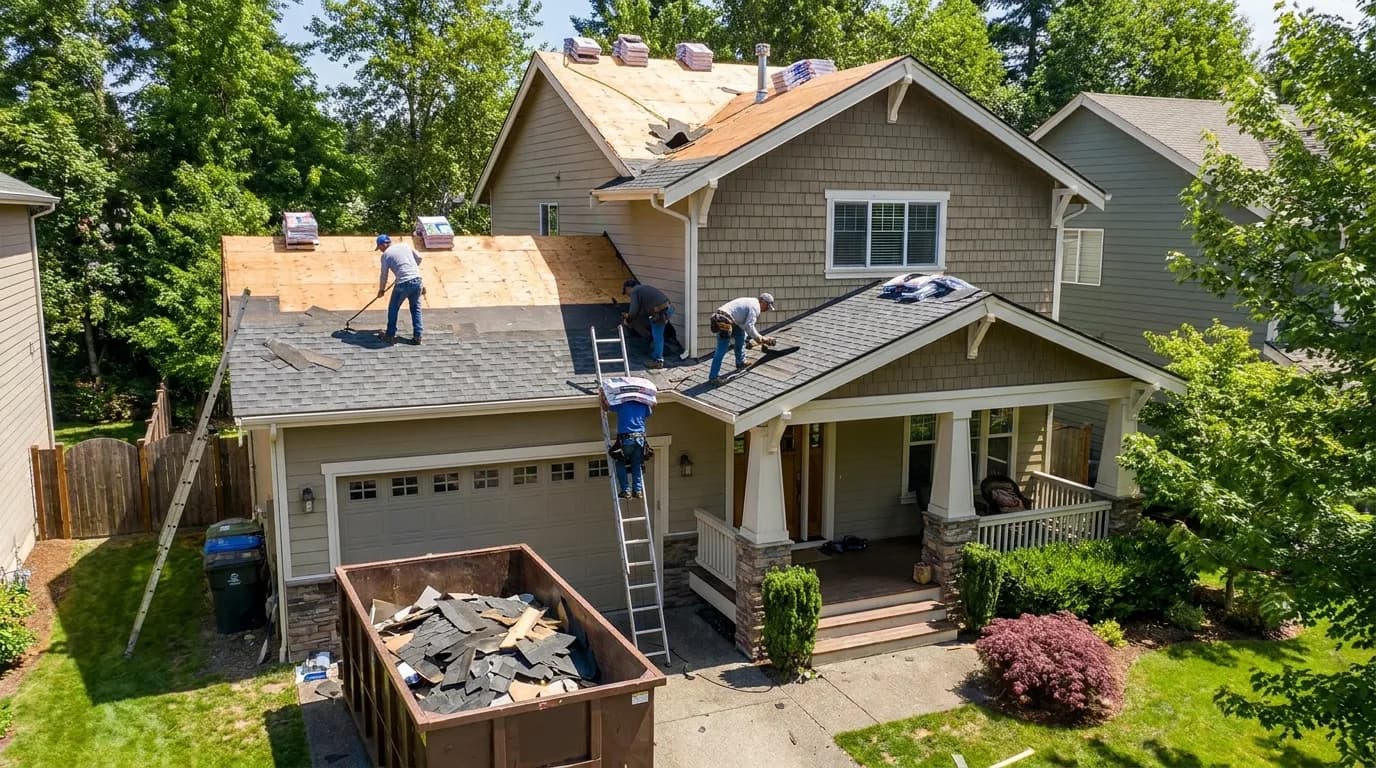
A full re-roof is one of the best times to deal with attic insulation cost, because a lot of the access work is already being done for other reasons. Old roof vents are typically swapped for new ones, the eaves are exposed while the drip edge and ice-and-water shield go on, and the crew is already set up with ladders and scaffolding. Adding baffles at the soffits, fixing a damaged vapour barrier, or topping up insulation at the same time shares that labour and setup instead of paying for it twice on two separate visits.
It also fixes problems in the right order. Insulating over a ventilation system that is undersized or unbalanced can trap moisture that a reroof would otherwise have corrected, so doing both together, rather than insulating first and re-roofing later, avoids doing part of the job twice. If you are pricing a new roof already, our roof replacement cost guide for Airdrie explains where ventilation and insulation add-ons typically sit in that overall number.
Timing also matters on its own, separate from a reroof. Fall, once the summer heat has cleared the attic but before the first hard freeze, is the practical window for most attic insulation work in Alberta, since blown material handles and settles more predictably above freezing and the attic is a far more comfortable place to work than it is in January. A mid-winter emergency top-up is sometimes unavoidable after an ice-dam problem shows up, but scheduling the work proactively in September or October, rather than reactively in February, is the cheaper and less stressful path for most Airdrie homeowners.
If your attic is showing any of the signs above, a free on-site estimate from Apex Roofing Airdrie looks at the roof, the vents and the attic together and gives you an itemised written quote for anything that needs work, insulation included, with no obligation to act on all of it at once.
Written by the Apex Roofing Airdrie crew
Practical guidance from the local roofers who inspect, repair and replace roofs across Airdrie and Rocky View County every season. We review our guides against current Alberta practice and update them when materials, code or insurer behaviour changes. About our team.