In this guide
- 01What Is EPDM Roofing? A Single-Ply Rubber Membrane Explained
- 02EPDM Roofing Cost in Alberta: Material vs Installed Price
- 03How Long Does an EPDM Roof Last?
- 04Where EPDM Roofing Works Best on an Alberta Home, and Where It Doesn't
- 05EPDM vs TPO vs PVC vs Modified Bitumen: An Alberta Comparison
- 06How EPDM Roofing Installation Works: Adhered, Fastened and Ballasted
- 07EPDM Roofing in Alberta's Climate: Hail, Chinook Wind and Freeze-Thaw
- 08Common EPDM Problems and When Repair Beats Replacement
- 09EPDM Maintenance: What Actually Extends the Roof's Life
- 10Insurance and EPDM Roofing After Hail or Wind Damage in Alberta
- 11Best Time to Install EPDM Roofing in Alberta
What Is EPDM Roofing? A Single-Ply Rubber Membrane Explained
EPDM roofing is a single-ply synthetic rubber membrane made from ethylene propylene diene monomer, the same rubber family used in some pond liners and door seals. It ships in wide rolls, commonly 3 to 15 m across, so most garage or dormer roofs need only one or two seams instead of dozens of shingle courses. That makes an EPDM rubber roof one of the simpler flat roofing systems to install correctly, provided the seams are done right.
Membrane thickness is sold in mils: 45 mil is the residential entry point, 60 mil is the common mid-grade choice for Alberta homes, and 90 mil shows up on commercial or high-traffic sections. Thicker membrane resists punctures better and tends to outlast thinner sheets. Colour is almost always black, which absorbs more solar heat than the white membranes used for TPO or PVC, though white EPDM exists and costs more.
Homeowners sometimes confuse EPDM roofing with Euroshield, a recycled-rubber shingle made in Calgary and shaped to look like cedar shake or asphalt. They share a raw material, ground-up rubber, but nothing else: Euroshield is a pitched-roof shingle installed like asphalt, while EPDM is a flat membrane seamed together in sheets. See our Euroshield rubber roofing guide for Alberta if that is the product you meant.
EPDM Roofing Cost in Alberta: Material vs Installed Price
EPDM roofing cost breaks into two very different numbers, and most of the confusion online comes from mixing them up. Material-only membrane, the rolled sheet with no labour, adhesive or flashing, runs roughly $4 to $7 per square foot as a rough 2026 Alberta market guide. Fully installed, with adhesive or ballast, seam tape, edge metal, flashing and labour, the same roof runs roughly $12 to $22 per square foot, or about $1,200 to $2,200 per square (a roofing square is 100 square feet).
| Installation method | Material-only (guide) | Fully installed (guide) | Notes |
|---|---|---|---|
| Fully adhered EPDM | $4-$6/sq ft | $14-$22/sq ft | Best wind resistance, most labour |
| Mechanically fastened EPDM | $4-$6/sq ft | $12-$18/sq ft | Faster install, visible fastener pattern |
| Ballasted EPDM (stone) | $3-$5/sq ft | $12-$16/sq ft | Cheapest per square, needs structural capacity for the stone |
Price moves with roof access, the number of penetrations (vents, drains, HVAC curbs), how much old material has to be torn off, and whether flashing and drip edge need replacing too. A small garage roof often lands at the high end of the range because a service call and a full day's labour do not shrink much on a small job. For repair pricing on an existing EPDM section, our flat roof repair cost guide breaks that down separately.
How Long Does an EPDM Roof Last?
A well-installed EPDM roof typically lasts 20 to 30 years, with many manufacturers offering warranties in the 15 to 20 year range and some premium 60 and 90 mil systems performing well past 30 years. That is roughly on par with a mid-grade architectural asphalt shingle roof, and our broader guide to how long a roof lasts in Alberta sets that lifespan against every other common material side by side.
What actually shortens an EPDM rubber roof rarely has anything to do with the membrane wearing out mid-sheet. UV breaks the surface down slowly over decades, but failures at year 10 or 12 almost always start at a seam, a flashing detail, or a low spot where water sits. Fully adhered systems tend to outlast ballasted ones because there is no stone shifting and abrading the membrane, and thicker sheets resist surface checking longer than thin ones.
Seam quality is the biggest lifespan variable, and the one homeowners have the least ability to judge by eye. A seam bonded with the right primer, rolled properly and cured at the right temperature can outlast the field membrane around it. A rushed seam, especially one installed in cold or damp conditions, is often the first thing to fail.
Where EPDM Roofing Works Best on an Alberta Home, and Where It Doesn't
EPDM roofing is a flat and low-slope product, not a general-purpose material, and the honest answer for most Airdrie houses is that it belongs on a small part of the roof rather than the whole thing. Garage roofs, additions, dormers, sunroom roofs, bay window tops and flat sections behind a parapet wall are the typical candidates. A standard pitched Alberta home with a conventional gable or hip roof is not an EPDM candidate at all; that roof wants asphalt, metal or one of the materials in our guide to the best shingles for Alberta's climate.
Manufacturer marketing sometimes glosses over that distinction and writes as though EPDM competes head-to-head with shingles across an entire roof. A full-roof EPDM installation on a typical Airdrie two-storey is unusual and, on anything with real pitch, the wrong system: EPDM suits slopes under roughly 2:12, and steeper roofs shed water fast enough that shingles, metal or another membrane make more sense. Expect two different systems on one house when a roof replacement in Airdrie covers a pitched main roof and a flat addition; that is normal, not a compromise.
Where EPDM does its best work is exactly the low-slope sections above, plus flat commercial and multi-unit roofs, which is part of why so much written about EPDM online is aimed at commercial buyers. Our wider guide to roof types used across Alberta homes sets EPDM alongside asphalt, metal, torch-on and every other common option side by side.
EPDM vs TPO vs PVC vs Modified Bitumen: An Alberta Comparison
The short answer for EPDM vs TPO is that EPDM is cheaper and easier to repair, while TPO reflects heat better and welds its seams instead of taping or gluing them. Both are single-ply membranes and both are common choices for flat sections on Alberta homes; PVC and torch-applied modified bitumen round out the field. The table below lines up the four systems against what actually matters here: cold performance, wind, hail and lifespan.
| Material | Cold flexibility | Hail resistance | Rough cost/sq ft installed | Typical lifespan |
|---|---|---|---|---|
| EPDM | Very good; stays pliable in deep cold | Punctures under a hard direct hit; otherwise dents and recovers | $12-$22 | 20-30 yrs |
| TPO | Good, but seams rely on hot-air welding done correctly | Reflective white surface shows hail bruising more visibly | $10-$18 | 15-25 yrs |
| PVC | Good; more rigid than EPDM in extreme cold | Slightly more puncture-resistant surface than EPDM | $14-$24 | 20-30 yrs |
| Torch-on (SBS) modified bitumen | Good; the SBS modifier keeps it flexible in cold | Granulated cap sheet resists punctures well | $10-$20 | 15-25 yrs |
For an Airdrie homeowner choosing between EPDM and a granulated cap sheet, our companion guide to torch-on roofing and SBS modified bitumen covers the torch-applied process in more detail. Cost, contractor familiarity and the specific roof detail, such as drains, curbs and parapet height, usually decide the choice more than any single performance number.
How EPDM Roofing Installation Works: Adhered, Fastened and Ballasted
EPDM roofing installation comes down to three attachment methods, and the right one depends on the roof deck, the building's wind exposure, and budget. Fully adhered systems bond the membrane to the deck, or to insulation board, with a liquid or spray adhesive across the entire surface. It is the most labour-intensive method and the most wind-resistant, because there is nothing for a gust to get under.
Mechanically fastened EPDM screws a batten bar or plate pattern through the membrane into the deck at set intervals, then seams over the fastener lines. It installs faster and costs a little less than fully adhered, but the fastener pattern has to be engineered for the local wind zone; done casually, it is the weak point in the system.
Ballasted EPDM lays the membrane loose over the deck and holds it down with round river stone or concrete pavers, usually 45 kg or more per square metre. It is the cheapest labour cost and easiest to repair, since moving stone exposes the membrane. The trade-off is weight: the structure must be engineered for the ballast load, and on an addition not designed for it, ballasted EPDM is often not an option.
Every method finishes the same way: seams are cleaned, primed and taped or glued with a 75 to 100 mm overlap, then rolled to press out trapped air. Edge metal and termination bars secure the perimeter, and flashing at drains, vents and walls is built up in layers, because that is where most flat roof leaks start.
EPDM Roofing in Alberta's Climate: Hail, Chinook Wind and Freeze-Thaw
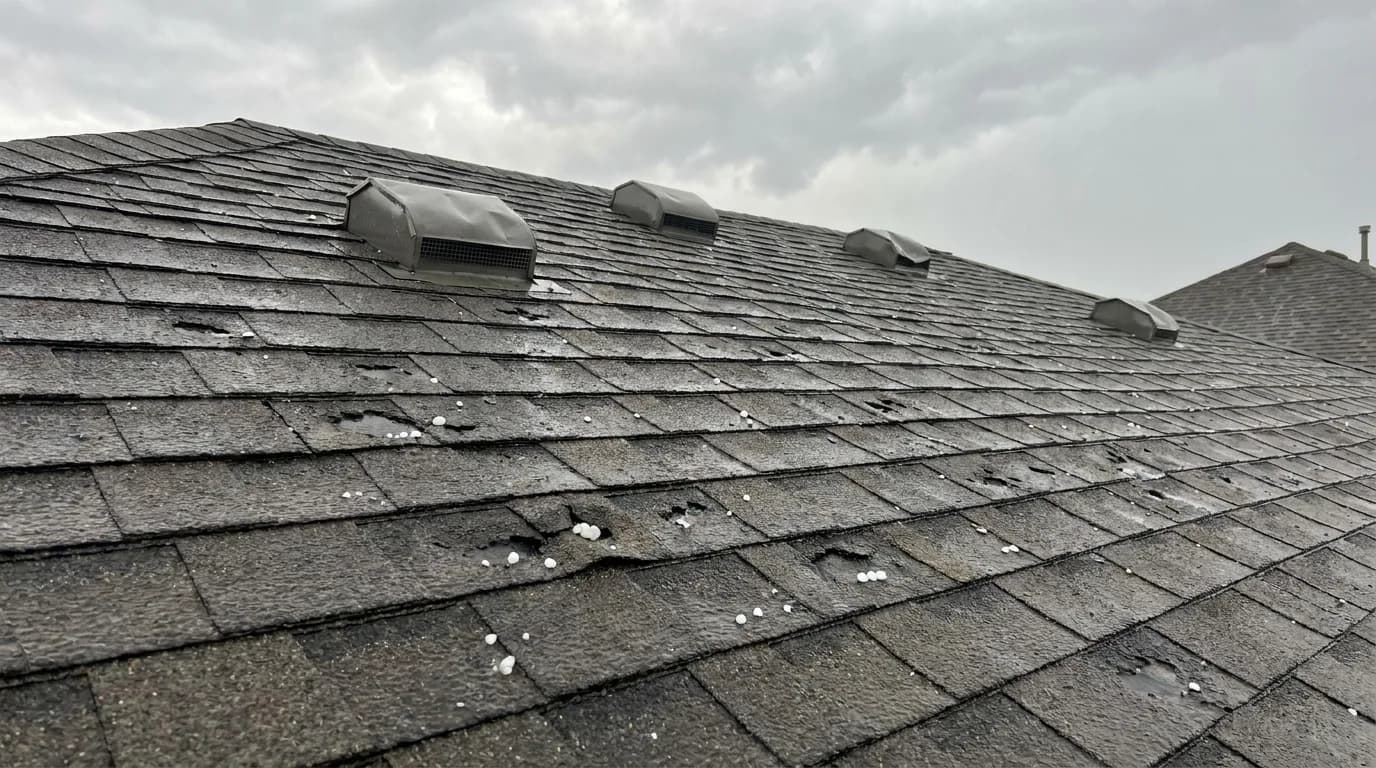
Hail behaves differently on an EPDM rubber roof than on asphalt shingles. Shingle hail damage is mostly cosmetic and granular: bruising, granule loss and soft spots. EPDM's failure mode under a hard, direct hailstone impact is a puncture or a split, particularly on thinner 45 mil membrane or membrane already stiffened with UV age. A membrane that dents and rebounds without breaking has taken no real damage; one that tears, even slightly, needs a patch before the next rain.
Chinook wind is the other Alberta-specific risk, and it hits ballasted EPDM hardest. A sudden Chinook can bring gusts strong enough to lift loose ballast stone at a roof edge or corner, and once ballast shifts, the membrane underneath is exposed to direct wind uplift. Fully adhered or properly engineered mechanically fastened EPDM is usually the better choice on an exposed Airdrie roof than a ballasted system, even though ballast costs less up front. TPO carries similar exposure when ballasted, while PVC and torch-applied membranes, being fully adhered or fused rather than loose-laid, generally handle wind better with less need for anchoring.
Freeze-thaw cycling is the least-discussed risk, and arguably the one that matters most over the life of the roof. Airdrie can swing from minus 20 to above freezing and back within a single week during a Chinook, and every cycle flexes the membrane and stresses seam adhesive and tape. Seams installed correctly, with the right primer and full cure time, tolerate this for decades. Seams installed in marginal weather, or with adhesive that never fully cured before the first freeze, tend to open up a few winters later, usually at a corner or T-joint where seam runs meet.
Common EPDM Problems and When Repair Beats Replacement
The disadvantages of EPDM roofing that actually cause claims and callouts cluster around a short list: seam failure, shrinkage, punctures and ponding water. Seam failure looks like a lifted edge or a gap along a taped joint and is the most common reason an otherwise sound EPDM roof leaks. Shrinkage happens on older membranes stretched too tight during installation; over years it pulls away from the perimeter flashing and opens a gap there instead of at a field seam.
Punctures come from foot traffic, dropped tools, satellite mounts or a fallen branch, and are usually the easiest to fix: a clean patch bonded over the hole, sized well beyond the damage, resolves most permanently. Ponding water, defined as water still standing 48 hours after rain, is a drainage problem rather than a membrane defect, but it accelerates every other failure mode here and needs a drainage fix, such as added drains or tapered insulation, rather than another membrane.
As a rule of thumb, a single seam or puncture repair on an EPDM roof under 15 years old is almost always worth doing. Multiple seam failures, widespread shrinkage at the edges, or a membrane past 20 to 25 years with surface checking across large areas is usually the point where a re-cover or full replace makes more sense than chasing leaks one at a time. Our roof repair service in Airdrie inspects flat sections and can tell you honestly which side of that line your roof is on.
EPDM Maintenance: What Actually Extends the Roof's Life
EPDM asks for less maintenance than a shingle roof, but less is not none. A twice-yearly walk of the membrane, spring and fall, catches most problems while they are still cheap to fix: look along every seam for lifting or gaps, check flashing at every penetration, and clear debris away from drains before freeze-up.
- Keep foot traffic off the membrane except where a walkway pad is installed; repeated foot traffic wears a thin track faster than UV ever will.
- Clear drains and scuppers before the first hard freeze so meltwater has somewhere to go all winter.
- Watch for ponding longer than 48 hours after rain and flag it for a drainage fix rather than living with it.
- Check exposed seams and terminations every spring for lifting or gapping after a hard winter.
- Reseal or recoat aging seams proactively once a membrane passes the 15-year mark.
A membrane roof rewards attention because most failures start small and stay small for a long time. A twice-yearly check is the cheapest way to keep a small repair from turning into a full replacement.
Insurance and EPDM Roofing After Hail or Wind Damage in Alberta
Any flat roof membrane Alberta homeowners have over a garage or addition is assessed differently after a hailstorm than a shingle roof: the adjuster is scoping a membrane, not counting bruised shingles, so the inspection looks for punctures, seam separation and torn sections rather than granule loss. Photographic documentation before and after a storm matters just as much as it does on a pitched roof, and a puncture that looks minor from the ground can be a real leak path.
ACV versus RCV settlement, deductibles and depreciation apply to EPDM claims the same way they apply to shingle claims, though how an insurer values a membrane roof, and whether depreciation is steeper on aging membrane than on aging shingles, varies by policy. Confirm the specifics with your insurer or broker. Our roof insurance claim service in Airdrie documents flat and pitched damage together when a storm hits both, common on a house with an EPDM garage roof and a shingled main roof.
Best Time to Install EPDM Roofing in Alberta
Adhesives and seam tape used in EPDM roofing installation have minimum application temperatures, typically in the range of 4°C to 10°C depending on the product, and they need that temperature to hold through the cure window, not just at the moment of application. That limits new EPDM installation in Alberta to a spring-through-fall window, roughly April through October, with the most predictable results from May to September.
Installing outside that window is not impossible, and some contractors use cold-weather adhesives or heated enclosures for emergency work, but a seam that cures marginally in October and faces its first hard freeze within weeks is worth watching closely the following spring. If a storm forces emergency flat-roof work in winter, a temporary repair that holds until a proper spring installation is usually the more reliable plan.
Written by the Apex Roofing Airdrie crew
Practical guidance from the local roofers who inspect, repair and replace roofs across Airdrie and Rocky View County every season. We review our guides against current Alberta practice and update them when materials, code or insurer behaviour changes. About our team.