In this guide
- 01Why a downspout extension matters more in Alberta than almost anywhere
- 02How far should downspouts extend from the house?
- 03Downspout extension types compared, with rough 2026 costs
- 04Splash blocks, diverters and rain barrels: what each one actually does
- 05Buried downspout drainage and pop-up emitters
- 06Winter problems: ice at the outlet and extensions lost to the snow blower
- 07The link between downspouts and basement leaks
- 08When a downspout problem is really an eavestrough pitch problem
- 09A ten-minute downspout check to do every spring and fall
- 10Get the whole drainage path checked, not just the outlet
Why a downspout extension matters more in Alberta than almost anywhere
A downspout extension is the least glamorous part of your roof drainage system and one of the most important. Your roof collects every drop of rain that falls on it and funnels it into four or five downspouts. A typical Airdrie two-storey with a 1,500 square foot roof footprint sends more than 1,400 litres of water through those outlets in a single 10 mm downpour. Without an extension, all of it lands in a 30 cm strip against the basement wall.
Most of Airdrie, from Cooper's Crossing to Big Springs, sits on heavy clay. Clay drains slowly, so water pooling at the foundation does not soak away; it sits, soaks into the backfill and pushes against the basement wall. When it freezes, it expands. When a Chinook thaws it and the next cold snap refreezes it, the cycle repeats. That freeze-thaw churn is what opens hairline cracks in foundations and pushes water into finished basements.
The fix is cheap and boring: get the discharge point away from the house and onto ground that slopes away. Everything in this guide comes back to that one idea. It is also one of the first items in our Alberta roof maintenance checklist, because a roof that sheds water well is only half the job if the water ends up in the basement.
How far should downspouts extend from the house?
The figure you will see most often is a minimum of 1.8 m (6 ft) from the foundation, and that is a sensible floor for Alberta clay. Many drainage contractors and home inspectors push for 2.5 to 3 m (8 to 10 ft) on flat lots or where the yard was backfilled with the clay that came out of the basement excavation, because that backfill settles and slopes back toward the house over the first decade.
Distance is only half the answer. The extension must discharge onto ground that falls away from the house at roughly 2 percent, which is about 15 cm of drop over the first 2 m, and it must not send water toward a neighbour's foundation, a window well, a walkway or a driveway. A 3 m extension that ends at the top of a slope back toward your own basement has done nothing.
On narrow side yards common in newer Airdrie subdivisions, 1.8 m may put the outlet on the property line. In that case, a buried line to the front or back yard, or a diverter that swings the outlet to run along the wall to a better discharge point, is the better answer. Do not compromise by shortening the extension; compromise by changing its direction.
Downspout extension types compared, with rough 2026 costs
Every hardware store carries half a dozen options and they are not interchangeable. The table below sets out what each type does well, where it fails, and a rough installed cost as of 2026. Treat the prices as market guides, not quotes; the parts are cheap and most of the cost in the higher rows is labour and excavation.
| Extension type | Best for | Weak points | Rough 2026 cost per downspout (guide) |
|---|---|---|---|
| Splash block (plastic or concrete) | Short-term, gentle slopes | Only moves water 60–90 cm; shifts and tilts on soft ground | $15–$60 supplied |
| Rigid hinged aluminum extension | Most homes; flips up for mowing | Gets knocked off by snow clearing; needs a second section for 1.8 m | $25–$80 supplied, $60–$150 installed |
| Flexible corrugated extension | Awkward angles, temporary use | Kinks, holds water, cracks in cold, looks untidy | $15–$40 supplied |
| Roll-out or recoiling extension | Lawns where a rigid pipe is in the way | Fails to unroll in light rain, splits after a few seasons | $20–$50 supplied |
| Buried line with pop-up emitter | Tidy yards, narrow side yards, chronic basement dampness | Excavation, freezing at the emitter, needs cleanouts | $300–$900 installed per run |
| Rain barrel with overflow | Garden watering, small roof areas | Overflow must still be extended; drain and disconnect before freeze-up | $100–$350 supplied |
For most Airdrie homes, two sections of hinged aluminum extension per downspout, secured with a screw at each joint, covers the 1.8 m minimum for well under $100. Buried lines are worth the money where a downspout lands in a side yard or where you have already had water in the basement. If you are pricing a full eavestrough replacement, our eavestrough cost guide for Airdrie explains where downspouts and extensions sit in the overall number.
Splash blocks, diverters and rain barrels: what each one actually does
A downspout splash block is not an extension. It is a shallow tray that stops the water jet from digging a hole in the soil and spreads it out 60 to 90 cm from the wall. On a lot that already slopes away hard, that can be enough. On flat Airdrie clay, it is not, and a splash block that has tilted back toward the house over a few winters actually funnels water to the foundation.
A downspout diverter is a hinged or rotating elbow that lets you change where the outlet points, either to swing an extension up out of the way or to switch between a rain barrel and a discharge line. Diverters are useful, but they add a joint, and every joint is a place for leaves and ice to collect. Check them in spring and fall along with the rest of the eavestrough downspout run.
Rain barrels are popular in Airdrie for garden watering because summer water restrictions come up most years. They do nothing for drainage on their own. A 200 litre barrel fills in the first few minutes of a serious storm and then overflows at the base of the wall, which is precisely what you were trying to avoid. Fit the overflow with its own extension, and empty and disconnect the barrel before the first hard freeze in October.
Buried downspout drainage and pop-up emitters
A buried downspout drainage line takes the water underground in solid (not perforated) 100 mm pipe and releases it through a pop-up emitter in the lawn 3 to 6 m away, or into a dry well or a rear-yard swale. It is the cleanest solution: nothing to trip over, nothing to knock off, and the discharge point can be anywhere the pipe reaches.
The Alberta caveat is frost. The emitter sits at the surface, so the last half metre of pipe freezes solid in winter, and if the line has any low spot the water sitting in it freezes too. Good installers slope the pipe continuously at 1 to 2 percent, add a cleanout near the downspout, and fit a winter bypass: a simple diverter at the base of the downspout that lets you send winter melt across the surface instead of into a frozen pipe.
Expect roughly $300 to $900 per run installed as of 2026, more if the trench crosses a walkway or the yard is landscaped. Before anyone digs, call Utility Safety Partners (the Alberta locate service) so gas and electrical lines are marked; it is free and it is required.
Winter problems: ice at the outlet and extensions lost to the snow blower
Alberta gives downspouts a hard time from November to March. Chinook thaws send meltwater down a downspout that ends in a frozen extension, so the water backs up and freezes in the pipe. By the third thaw the lower elbow is a solid plug and the next melt overflows at the top of the downspout, straight down the wall. In a bad case the weight of ice splits the seam of the downspout itself.
The second winter problem is mechanical. Hinged extensions that have been left down get buried in the first big snowfall and then sheared off by a snow blower or a shovel. Flexible extensions get crushed. By spring, one or two downspouts are discharging at the wall again and nobody has noticed. Flip hinged extensions up before the snow, or mark them with a stake, and walk the house after every snow clearing.
The third is the one that gets people hurt. An extension that discharges onto a walkway or driveway builds a sheet of ice with every Chinook cycle. If a downspout lands within 2 m of a path, redirect it before winter, even if that means a temporary diverter until you can bury a line. For the same freeze-thaw reasons, our guide on how to prevent ice dams in Airdrie is worth reading alongside this one; the same warm attic that feeds ice dams is often what keeps meltwater running into a frozen downspout.
The link between downspouts and basement leaks
Ask a foundation repair company where most basement water comes from and the answer is usually the roof. A single missing or disconnected downspout extension concentrates thousands of litres a season against one section of wall. On clay, that water sits in the backfill, saturates it, and finds the cold joint between the footing and the wall, a tie-rod hole, or a settlement crack.
The pattern is predictable: a damp corner of the basement that shows up after heavy rain or a big spring melt, always on the same wall, often under the downspout you have not thought about. Before you pay for interior weeping tile or crack injection, walk the outside of the house during a rainstorm and watch where every downspout actually discharges.
Grading is the other half. Backfill around a 10 to 20 year old Airdrie home has usually settled, so the ground now slopes toward the wall in places. Topping up with clay (not topsoil, which is porous) to restore a fall of about 15 cm over 2 m, then extending the downspouts beyond that graded strip, fixes most recurring basement dampness without any interior work.
When a downspout problem is really an eavestrough pitch problem
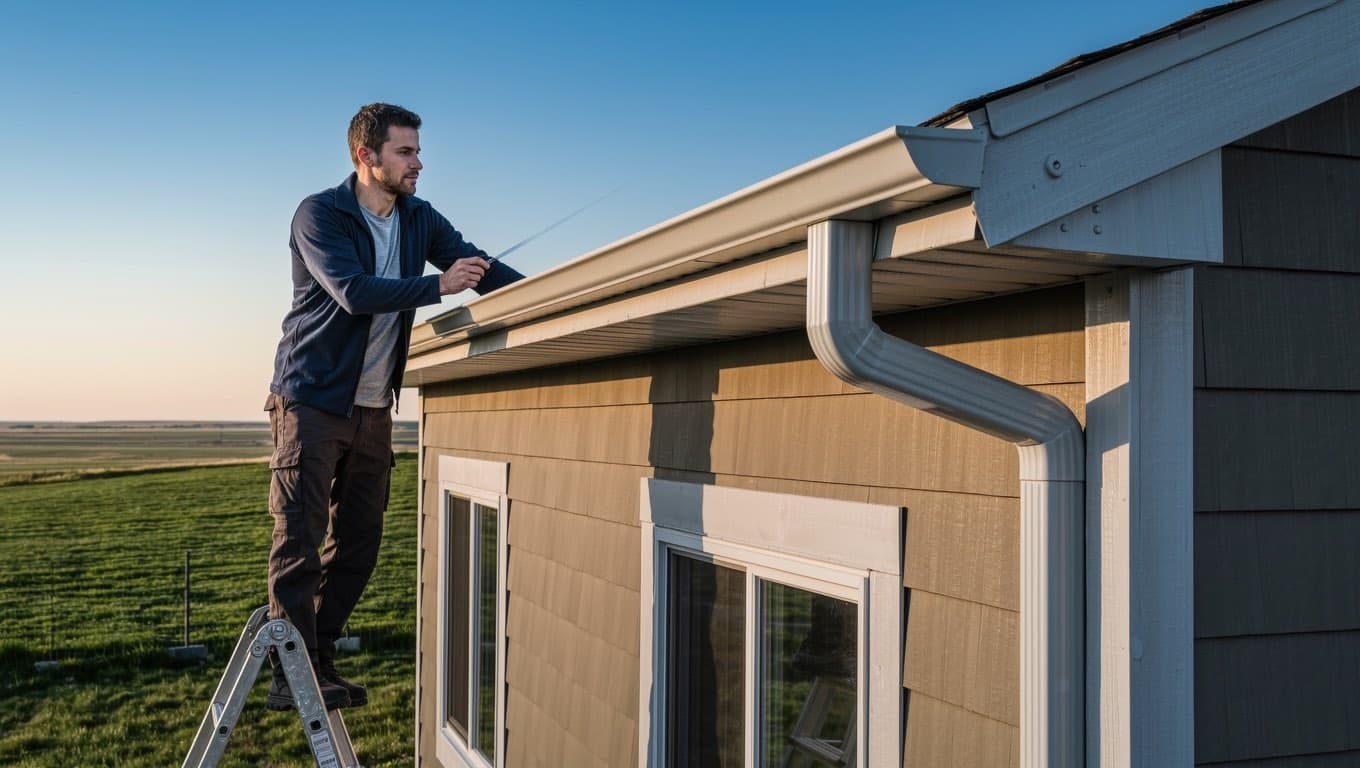
Not every drainage failure is at the outlet. If water sheets over the front edge of the eavestrough in a storm, pools in one section and drips for hours afterward, or overflows at a corner while the downspout below runs at a trickle, the extension is not the issue. The eavestrough is not delivering water to the downspout in the first place.
Eavestroughs should fall toward the downspout at roughly 6 mm per 3 m (a quarter inch per 10 ft). Hangers pull loose over time, especially after a winter of ice loading, and a section that has sagged or reversed its slope will hold water. That standing water freezes, the ice pulls the trough further off the fascia, and the cycle accelerates. Clogged outlets do the same thing in one spot.
Look at the trough from the ground after a rain: staining or tiger-striping on the outside face, a visible dip, or a downspout that runs while its neighbour is dry all point to a pitch or blockage problem. Our eavestrough repair and replacement service in Airdrie, and the same eavestrough service in Calgary, re-pitches and re-hangs troughs, clears outlets and fits properly sized downspouts, and we will tell you if the rest of the run is sound. If the fascia behind the trough has gone soft, that is a separate job; see our guide to soffit and fascia replacement cost.
A ten-minute downspout check to do every spring and fall
You do not need a ladder for most of this. Do it during or just after a decent rain if you can, because that is when the problems show themselves.
- Count the downspouts and confirm each one has an extension that discharges at least 1.8 m from the wall.
- Check the discharge point: ground sloping away, not onto a walkway, driveway, window well or the neighbour's foundation.
- Look at the joints: extensions pushed on without a screw work loose; elbows packed with leaves or shingle granules block.
- Watch the flow: a downspout that gurgles, overflows at the top or runs at a trickle in a storm is blocked or the trough above is mis-pitched.
- Check for splash marks on the siding or foundation below each outlet; they show where water is landing.
- Before winter: flip hinged extensions up or stake them, disconnect rain barrels, and open the winter bypass on any buried line.
- After each snow clearing: walk the house and reset any extension that has been knocked off.
Ten minutes twice a year catches almost everything. If you would rather have it done alongside a shingle and flashing check, our roof maintenance service in Airdrie includes the eavestroughs and downspouts in the same visit.
Get the whole drainage path checked, not just the outlet
Water leaves your house along one path: shingles to eavestrough to downspout to extension to graded ground. A weak link anywhere along it ends up in the basement or as ice on the walk. Extensions are the cheapest link to fix, and this guide should let you handle them in an afternoon.
If the trough is overflowing, sagging or pulling off the fascia, or you are seeing water in the basement despite good extensions, that is where a free on-site look from Apex Roofing Airdrie helps. We check the eavestroughs, downspouts, fascia and the roof edge above them in one visit and give you an itemised written quote for anything that needs work, with no obligation. And if the shingles above the eaves are curling or shedding granules into the downspouts, our pillar guide to the signs you need a new roof will help you decide how urgent that is.
Written by the Apex Roofing Airdrie crew
Practical guidance from the local roofers who inspect, repair and replace roofs across Airdrie and Rocky View County every season. We review our guides against current Alberta practice and update them when materials, code or insurer behaviour changes. About our team.